
Emergency Roof Leak Repair: What Counts as an Emergency and What to Do Right Now
Emergency roof leak repair is needed when water is actively entering your home and you can’t wait for a scheduled appointment — during a storm, in the middle of the night, or when the leak is getting worse by the hour. If that’s you right now, skip ahead to the 30-minute action plan below. Everything else on this page can wait.
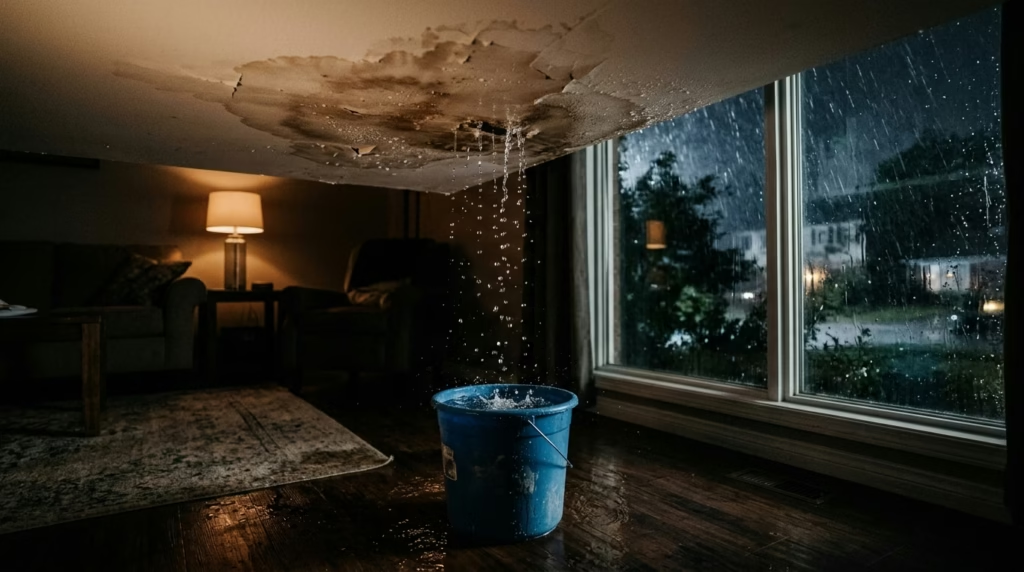
The goal in an emergency isn’t a perfect repair. It’s to limit damage, stay safe, and buy time until a professional can do the real fix. Here’s how to think clearly when water is coming through your ceiling.
What Counts as a Roofing Emergency?
Call for emergency help now if any of these are true:
- Water is actively dripping or streaming in — especially in multiple spots or spreading across a ceiling.
- A ceiling is sagging or bulging — that’s trapped water, and it can collapse. Keep people and furniture away from underneath it.
- Water is near electrical fixtures — outlets, light fixtures, ceiling fans, or your breaker panel. This is a safety emergency first, a roof emergency second.
- Storm damage is visible — missing shingles, a fallen branch through the roof, or a hole you can see daylight through.
- The leak started suddenly during a storm — sudden onset usually means storm damage, which also matters for insurance.
A slow stain that’s been there for weeks and isn’t getting worse? That’s urgent, but it’s not an emergency — schedule a normal inspection. Knowing the difference saves you the after-hours premium when you don’t need it, and gets you help faster when you do.
Your First 30 Minutes: Stop the Damage {#your-first-30-minutes-stop-the-damage}
Do these in order. Don’t go on the roof — not in the dark, not in the rain, not in the wind.
1. Protect people and electricity (minutes 0–5)
- If water is dripping near any light fixture, outlet, or switch, turn off the breaker for that circuit. Water + electricity kills.
- Move people away from sagging ceilings. A waterlogged section of drywall can weigh 50+ pounds and let go without warning.
- Put on shoes — wet floors with debris are a slip and cut hazard.
2. Contain the water (minutes 5–15)
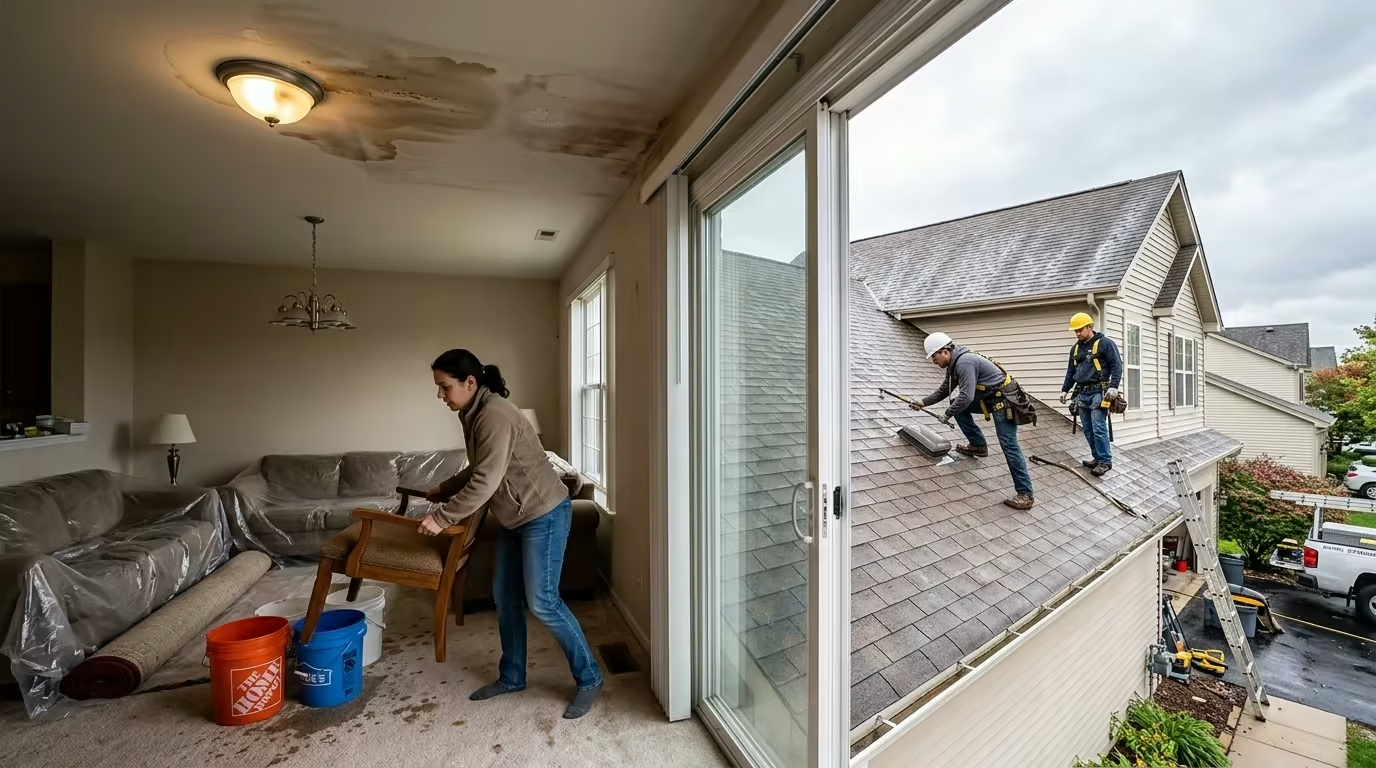
- Place buckets, pots, or trash cans under drips. Put a towel in the bottom of each container to deaden the splash and keep water from bouncing out.
- Lay towels or old blankets along the drip path. Move rugs, electronics, and furniture out of the area.
- If a ceiling is bulging with trapped water, you can relieve it with a small controlled puncture: poke a pencil-sized hole at the lowest point of the bulge with a screwdriver and let it drain into a bucket. This sounds scary but it prevents a much bigger uncontrolled collapse. (Skip this if water is near electrical fixtures — call for help instead.)
3. Slow the source if you safely can (minutes 15–30)
- From inside the attic (only if you have safe access and it’s not storming dangerously): lay a tarp or plastic sheeting over the wet area of the roof deck, funneling water toward a bucket. Don’t touch wet insulation with bare hands if you can avoid it.
- Do NOT go on the roof during an active storm, at night, or on a wet/icy surface. No leak is worth a fall. Temporary exterior fixes wait for daylight and safe conditions — see our guide to temporary roof repair.
4. Document everything (while you wait)
Take photos and video of the leak, the water path, damaged belongings, and — once it’s safe and light — the roof itself. Note the date and time the leak started and what the weather was doing. If this was storm damage, this documentation is the foundation of an insurance claim.
5. Call for emergency help
For Carol Stream and nearby suburbs, call Carol Stream Leak & Restoration at (630) 866-1445 — we can connect you with a local professional for emergency service. When you call any emergency roofer, have this info ready: your address, where the water is coming in, whether it’s near electricity, and whether there’s visible exterior damage.
What Emergency Roofers Actually Do
An emergency visit is about stabilization, not a finished repair:
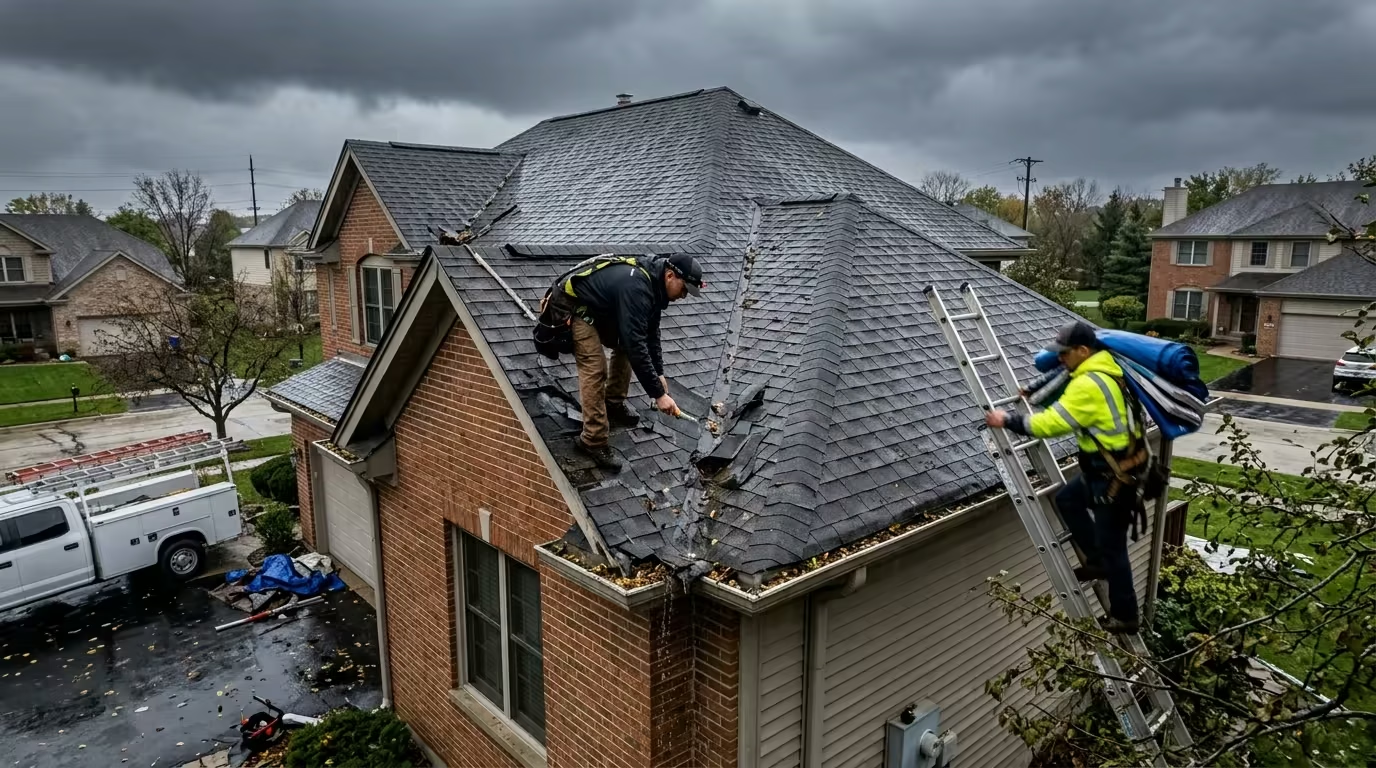
- Temporary weatherproofing — tarping the damaged area, sealing the breach, or installing an emergency patch. This stops water entry so the permanent repair can be scheduled properly.
- Damage assessment — identifying the entry point, checking how far water traveled, and looking for decking damage and interior impact.
- A plan and a written quote for the permanent fix, usually scheduled within days.
What to Expect When the Pro Arrives
A good emergency visit follows a predictable pattern, so you’ll know you’re in competent hands:
- They secure the scene first — tarps and containment before diagnosis. Stopping active water matters more than finding the exact entry point in the dark.
- They photograph everything — both for your insurance claim and their own records. Ask for copies.
- They check the attic — water’s entry point and travel path tell them how extensive the permanent repair will be.
- They give you a written stabilization receipt and a separate quote for the permanent repair. These are two different jobs with two different prices. If someone quotes you a single number at 2 AM for everything, ask them to split it — you want to compare the permanent repair against other bids in daylight.
- They tell you what’s safe and what isn’t — which rooms to avoid, whether the breaker should stay off, and when it’s safe to use the space again.
Emergency service typically costs $200–$600 for the stabilization visit (tarps, emergency patching, after-hours labor), separate from the permanent repair. Our 2026 roof leak repair cost guide has full pricing details.
What NOT to Do in a Roofing Emergency
- Don’t climb on a wet, icy, or wind-blown roof. Every year people are seriously injured doing this. Wait for daylight and safe conditions.
- Don’t use a garden hose to “find the leak” during a storm. You’ll just add water to the problem.
- Don’t ignore a sagging ceiling. It’s not “just a stain” — it’s structural weight that can fail.
- Don’t wait until morning if water is near electricity. Kill the breaker and call for help.
- Don’t sign anything under pressure. An emergency stabilizes the situation; the permanent repair quote deserves your calm attention and a second opinion if it’s large.
After the Emergency: Next Steps
Once the water is stopped and things are dry:
- Get the permanent repair scheduled — emergency patches are temporary by design. Most last weeks, not months.
- Check your attic once things dry out: look for damp insulation, stained decking, and mold. Wet insulation loses its R-value and needs replacing.
- Review your insurance — if a storm caused the damage, file promptly. Most policies require timely reporting. (Flat or low-slope section leaking? The diagnosis differs — see our flat roof leak repair.)
- Follow our step-by-step guide for a leaking roof for the full calm walkthrough of inspection, quotes, and repair.
Frequently Asked Questions
How much does emergency roof leak repair cost?
The emergency stabilization visit (tarping, temporary patch, after-hours labor) typically runs $200–$600 in the Chicago suburbs. The permanent repair is quoted separately — see our cost guide and Carol Stream roof leak repair cost for those ranges.
Will a roofer come out at night or during a storm?
Most emergency roofers will come out at night, but no reputable crew will go on a roof during lightning, high winds, or icy conditions. In those cases they’ll help you with interior containment over the phone and arrive as soon as it’s safe.
How long does an emergency tarp last?
A properly secured professional tarp lasts several weeks to a few months. It’s a bridge to the permanent repair, not a solution — UV and wind degrade tarps, and water can still find edges.
My ceiling is sagging but not dripping — is that an emergency?
Yes, treat it as one. A sagging ceiling means water is pooled above the drywall. Keep the area clear, and relieve it with a small controlled drain hole into a bucket if there’s no electrical nearby — or call for help.
Does homeowners insurance cover emergency roof repairs?
If the cause was a sudden event (storm, fallen tree, hail), usually yes — including reasonable emergency mitigation costs. Document everything and keep receipts for tarps, buckets, and emergency service.
Can I do emergency roof repair myself?
Interior containment — absolutely. Exterior work in dangerous conditions — no. Once it’s safe and dry, a homeowner can apply a temporary patch (see our temporary repair guide), but the permanent fix belongs to a professional.
Water coming in right now? Don’t wait.
Further Reading
- This Old House: Emergency Roof Leak Repair Costs & Safety — what counts as a roofing emergency and how to stay safe
- Family Handyman: 12 Tips for Finding and Fixing Roof Leaks — practical leak-detection tips for homeowners
External links open in a new tab and are provided for reference; we are not affiliated with these publishers.
Roof leaking in Carol Stream? Get help fast.
Call Carol Stream Leak & Restoration at (630) 866-1445 — we'll connect you with a local repair professional serving Carol Stream, Bloomingdale, Glendale Heights, Wheaton, Hanover Park, Bartlett, and West Chicago. Related service: Emergency Roof Leak Repair in Carol Stream, IL.
Carol Stream Leak & Restoration is a local referral service that connects homeowners with independent local repair professionals; it is not a roofing contractor.