
7 Signs of a Roof Leak Inside Your Home (Ceiling & Attic)
Most roof leaks announce themselves quietly. By the time water is dripping onto your floor, it has often been traveling through your attic and ceiling for weeks or months. Knowing the signs of roof leak damage early is the cheapest home-maintenance skill a homeowner can have — a stain caught in month one is a minor repair; the same leak ignored for a year can mean rotted decking, mold remediation, and a five-figure bill.
Walk through these seven signs room by room. If you recognize even one, it’s worth investigating — and our guide on how to find a roof leak shows you exactly how to trace it to its source.
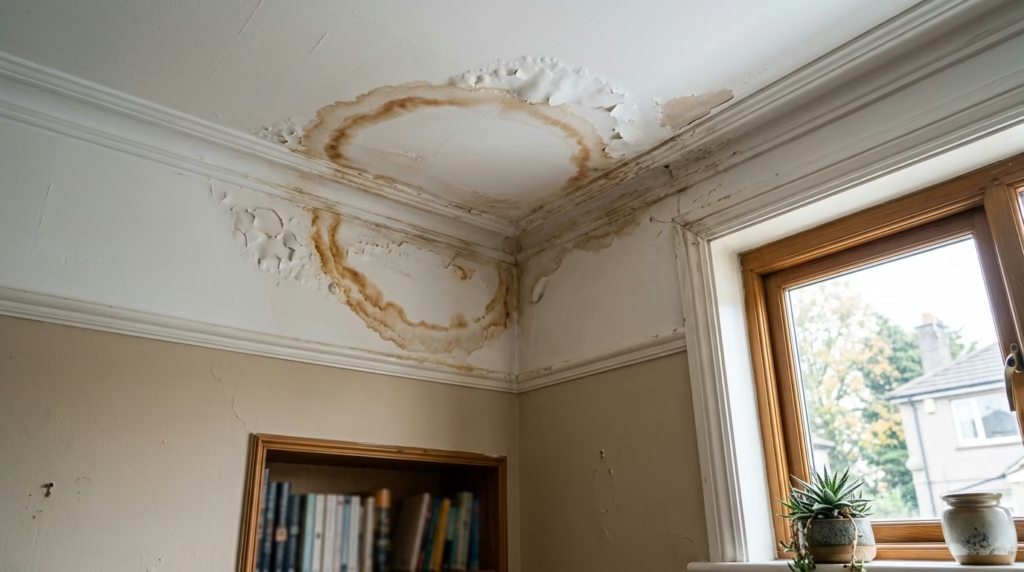
Sign 1: Brown or Yellow Water Stains on Ceilings
The classic sign. Water stains appear as discolored rings or blotches — usually brown, yellow, or copper-toned — on ceilings and sometimes upper walls. They often have a darker outer ring with a lighter center, and they grow with each rain.
What to do: Don’t just paint over it. A stain means water got through — painting hides the evidence while the leak continues. Note when the stain appears or darkens (after rain = roof), photograph it with a date, and trace it using the attic method. And before you assume, rule out the alternative with our guide on roof leak vs plumbing leak.
Sign 2: A Musty or Moldy Smell — Especially Upstairs
Your nose often finds a leak before your eyes do. A persistent musty odor in an upstairs bedroom, hallway, or closet — particularly one that worsens after rain — signals trapped moisture feeding mold growth inside the ceiling cavity or attic.
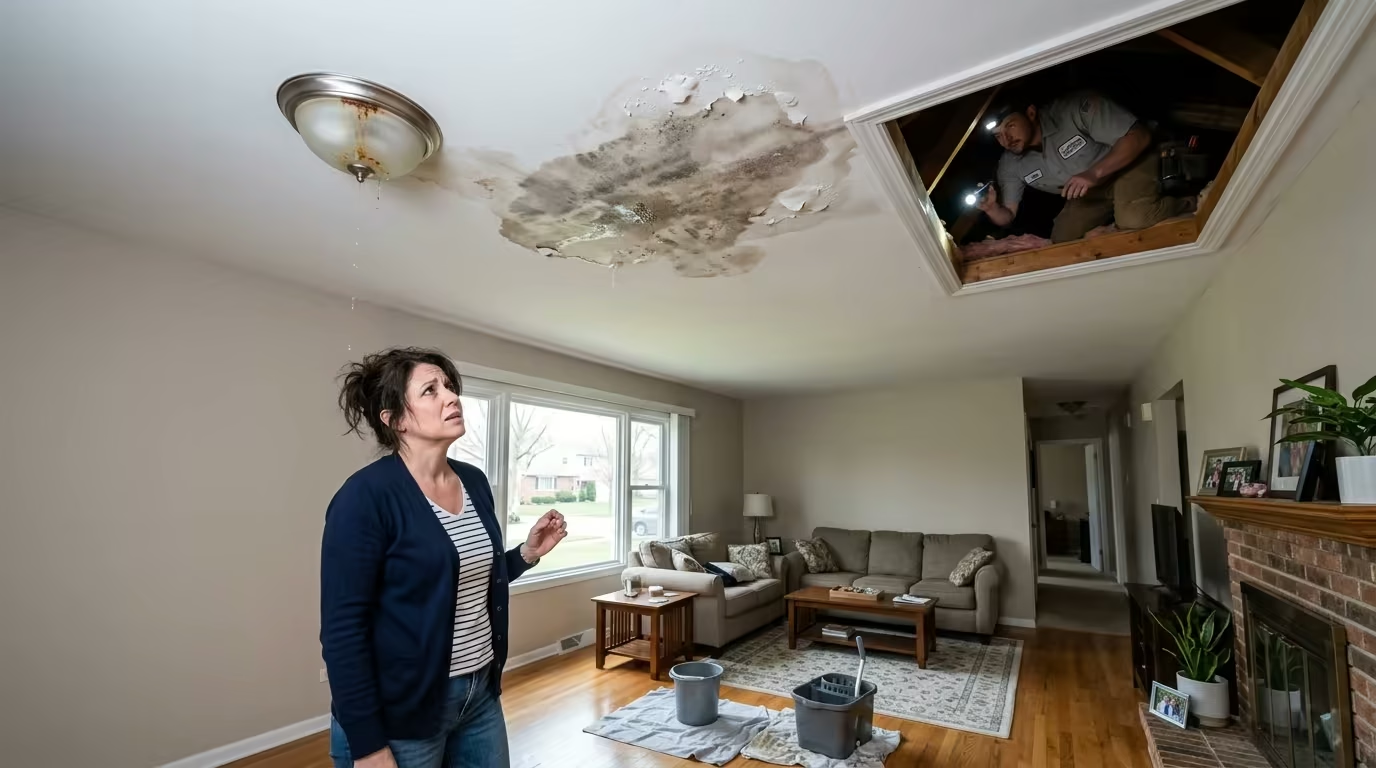
Mold from roof leaks typically grows on the back side of drywall, on attic wood, or in damp insulation — all places you can’t see without looking. If you smell it, investigate: check the attic above that room for damp insulation, darkened wood, or visible mold colonies. Mold isn’t just a smell issue; prolonged exposure aggravates allergies and asthma, and mold remediation gets expensive fast once it spreads through insulation.
Sign 3: Peeling, Bubbling, or Flaking Paint
When moisture pushes through drywall from behind, paint loses adhesion. Look for:
- Bubbling or blistering paint on ceilings or upper walls
- Peeling paint that reveals damp drywall underneath
- Flaking or crumbling texture on ceiling finishes
This sign is easy to misread as “old paint” or humidity. The tell: it appears in one localized area rather than throughout the room, and it recurs after you repaint. Exterior paint peeling on soffits or fascia boards is the outside version of the same warning — water is getting where it shouldn’t, often from overflowing gutters or failed drip edge.
Sign 4: Sagging or Soft Drywall
This is the sign that means act now. Drywall that sags, feels soft or spongy to the touch, or visibly bows downward is saturated with water — and saturated drywall can collapse without warning, dumping water and debris onto whatever is below.
If you see a bulge: place a bucket underneath immediately. You can carefully relieve it by poking a small hole at the lowest point of the bulge with a screwdriver, letting trapped water drain into the bucket in a controlled way. This prevents a sudden, destructive collapse. Then call for professional help — saturated drywall needs to be cut out and replaced, and the leak above it must be repaired first or the new drywall will just get wet again.

Sign 5: Dripping Sounds or Active Drips in the Attic
Sometimes the clearest sign is auditory. During or after rain, go to your attic (safely — stepping only on joists, flashlight in hand) and listen. Dripping sounds, or visible drips falling from the roof deck, rafters, or nails, confirm an active leak.
Also look for:
- Wet spots on the underside of the roof deck — dark, damp patches on plywood or boards
- Damp or compressed insulation — wet fiberglass clumps and loses its insulating value
- Water trails running down rafters or along pipes — follow them uphill to find the entry point
- Rust on nail tips protruding through the deck — chronic moisture leaves its mark on fasteners
Even without active dripping, older dried stains on attic wood tell you a leak has visited before — and intermittent leaks still cause cumulative damage.
Sign 6: Higher Energy Bills Without Explanation
This one surprises people. A roof leak soaks attic insulation, and wet insulation barely insulates. Your furnace and air conditioner then work harder to maintain temperature — and your utility bills creep up with no other explanation.
If your energy bills have risen and you’ve already checked the usual suspects (thermostat settings, HVAC filters, drafty windows), consider the attic. Damp insulation, visible daylight through the roof deck, or poor attic ventilation all degrade thermal performance. Illinois winters make this worse: heat escaping through a wet, under-insulated attic melts roof snow unevenly, which feeds ice dam roof leak — a leak causing a leak.
Sign 7: Exterior Signs of Roof Leak You Can Spot from the Ground
The inside signs have outside counterparts. From your yard with binoculars — or from a securely placed ladder — look for:
- Missing, cracked, or curled shingles
- Dark streaks or patches where protective granules have worn off
- Damaged or rusted flashing around chimneys, vents, and skylights
- Sagging or overflowing gutters pulling away from the fascia
- Moss or algae growth holding moisture against shingles
- Debris piled in roof valleys where two slopes meet
Exterior damage doesn’t guarantee an active interior leak — but every one of these is a future leak in progress. Catching them during a ground-level scan is exactly what our how to prevent roof leaks is designed for.
How These Signs Progress Over Time
Understanding the timeline helps you gauge urgency:
| Stage | Timeline | What You See | Damage Level |
|---|---|---|---|
| Early | Weeks 1–4 | Faint stain, slight musty smell | Surface drywall staining; minor repair |
| Developing | Months 2–6 | Darker growing stain, peeling paint | Drywall damage; possible insulation saturation |
| Advanced | Months 6–12 | Sagging drywall, visible mold, drips | Structural wood moisture; mold remediation likely |
| Severe | 1+ year | Ceiling collapse risk, rot, widespread mold | Decking/framing repair; major remediation |
The lesson: a faint stain today is the cheapest version of this problem you will ever see. Every month of delay moves you one row down this table.
What to Do When You Spot Any of These Signs
- Document it. Photograph the sign with dates. If it’s a stain, mark its outline lightly in pencil so you can tell whether it’s growing.
- Determine the source. Use the rain-timing test: does it worsen after rain? If yes, it’s the roof — trace it using the attic method described in our detection guide.
- Contain active water. Buckets under drips, towels around the base, furniture moved. Relieve bulging drywall as described above.
- Get a professional assessment. A qualified local roofer can confirm the source and quote the repair — most minor leak repairs are far cheaper than the water damage they prevent. For skylight or roof vent areas, the fix is often a straightforward flashing or boot replacement.
Frequently Asked Questions
How long can a roof leak go unnoticed?
Easily months. Small leaks drip into insulation or run down rafters without ever reaching your ceiling in visible amounts. Many homeowners discover a leak only when a stain finally appears — by which point the attic above it has been wet for a long time. Annual attic checks catch these silent leaks early.
Is a small water stain an emergency?
It’s not a call-911 emergency, but treat it as urgent. A small stain means an active entry point that will grow with every storm. Schedule an inspection within days. The exception: sagging or bulging drywall, active heavy dripping, or water near electrical fixtures — those need same-day attention.
Can I just paint over a water stain?
Only after the leak is repaired and the area is fully dry. Painting over an active leak traps moisture, guarantees the stain bleeds back through, and hides the warning sign while damage continues. Use a stain-blocking primer on the repaired, dry surface — not as a substitute for repair.
Why does the stain keep coming back after I painted it?
Because the leak above it is still active. Recurring stains are proof the source was never fixed — the water keeps arriving and pushing through your new paint. Stop repainting and fix the roof entry point first.
Do roof leaks always leave stains?
No. Leaks that drain into wall cavities, drip onto attic floors, or evaporate between rains may never stain a ceiling. That’s why the attic inspection matters: the underside of the roof deck shows every leak, stained ceiling or not. Unexplained musty smells and rising energy bills are the clues for stain-free leaks.
See a Sign? Get It Checked Before the Next Rain
Further Reading
- Family Handyman: 10 Roof Problems and What to Do About Them — common roofing problems and their fixes
- This Old House: How to Find and Fix a Roof Leak — step-by-step leak-finding and repair walkthrough from a trusted home-improvement source
External links open in a new tab and are provided for reference; we are not affiliated with these publishers.
Roof leaking in Carol Stream? Get help fast.
Call Carol Stream Leak & Restoration at (630) 866-1445 — we’ll connect you with a local repair professional serving Carol Stream, Bloomingdale, Glendale Heights, Wheaton, Hanover Park, Bartlett, and West Chicago.
Carol Stream Leak & Restoration is a local referral service that connects homeowners with independent local repair professionals; it is not a roofing contractor.