
Flat Roof Leak Repair: Common Causes & Fixes
Flat roof leak repair works differently from shingle roof repair. There’s no slope to shed water, so every weak seam, puncture, or drainage problem becomes a leak waiting for the next rain. The good news: most flat roof leaks are very fixable — if you address the cause, not just the symptom.
This guide covers the most common causes of flat roof leaks, how each one is properly repaired, what it costs, and when a repair stops making sense. It applies to homes with low-slope sections (porches, additions, garages) as well as commercial buildings around Carol Stream.
Why Flat Roofs Leak: The 6 Most Common Causes
1. Ponding Water
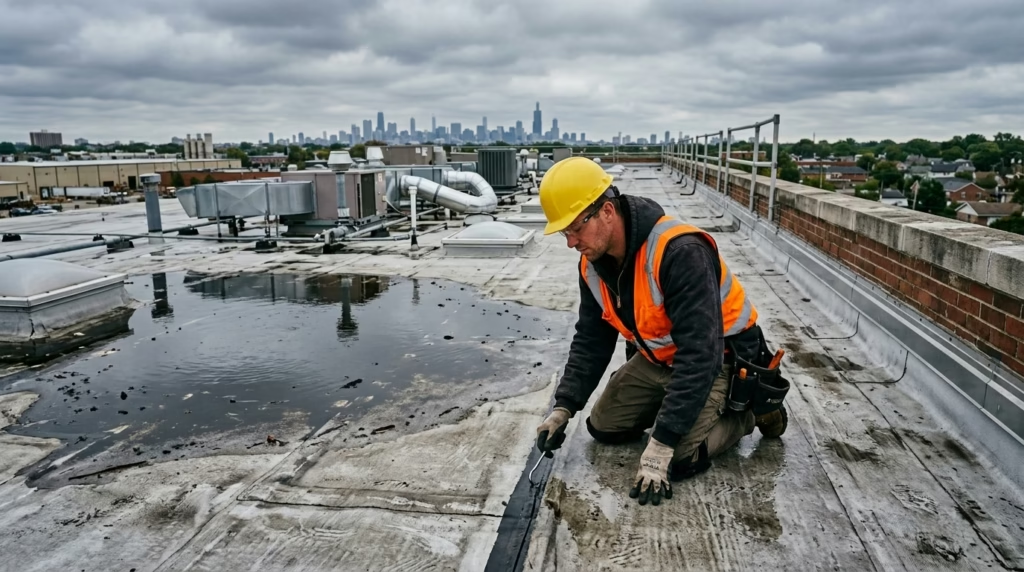
“Flat” roofs aren’t truly flat — they’re built with a slight slope (usually ¼ inch per foot) toward drains. When that slope is compromised by settling, sagging decking, or clogged drains, water ponds. Any water standing for more than 48 hours after rain is a problem: it accelerates membrane aging, finds micro-cracks, and adds enormous weight (a single inch of water over 1,000 sq ft weighs over 5,000 lbs).
Fix: Clear drains and scuppers first — clogs cause most ponding. Persistent low spots may need tapered insulation to restore slope, or additional drains. Patching the membrane without fixing drainage guarantees a repeat leak.
2. Membrane Punctures and Tears
Foot traffic, fallen branches, HVAC technicians, and even dropped tools puncture membranes. EPDM (rubber) and TPO (thermoplastic) membranes are tough but not invincible — a single puncture is often the entire “mystery leak.”
Fix: Clean the area, apply manufacturer-compatible primer, and install a membrane patch extending at least 6 inches past the damage on all sides. EPDM patches use seam adhesive or tape; TPO patches are heat-welded. The key detail: the patch material must be compatible with the existing membrane — the wrong adhesive on the wrong membrane fails fast.
3. Failed Seams
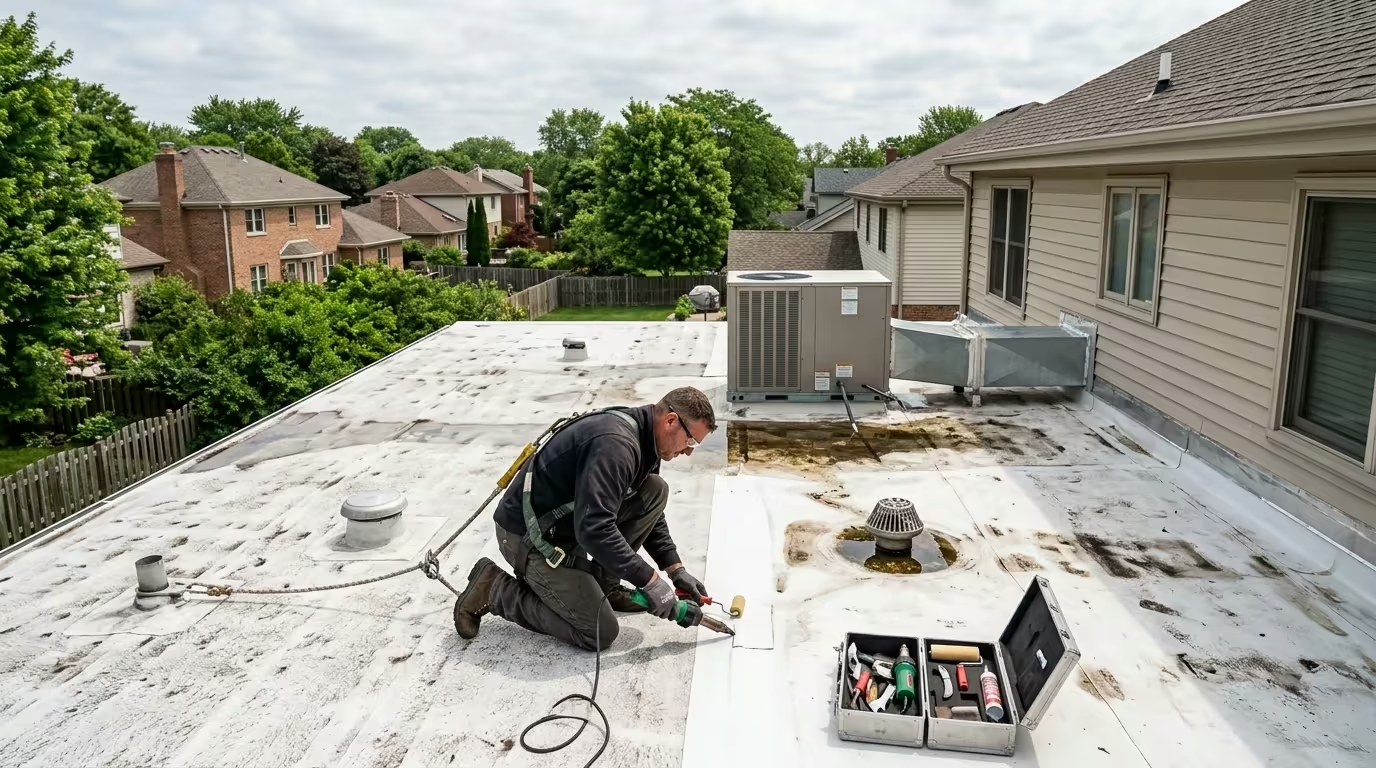
Membranes come in sheets, and the seams between sheets are the most vulnerable points. Adhesive seams (EPDM) can delaminate with age and UV exposure; even heat-welded TPO seams fail if they were poorly welded during installation.
Fix: Re-seal with compatible seam tape or re-weld the seam, extending the repair past the failed section. Widespread seam failure across the roof is a sign the membrane is at end of life.
4. Flashing Failures
Where the membrane meets walls, parapets, vents, skylights, and HVAC curbs, flashing creates the waterproof transition. This is the #1 leak location on flat roofs — flashing pulls away, sealant cracks, and pitch pans dry out.
Fix: Re-flash with new membrane and compatible sealant; replace dried-out pitch pan filler. On parapet walls, check that the coping (the cap on top of the wall) is intact — failed coping lets water behind the flashing.
5. Blisters and Bubbles
Trapped moisture or air under the membrane forms blisters. Small, stable blisters are often just cosmetic — but blisters that grow, crack open, or sit in ponding areas become leak points.
Fix: Small intact blisters can be monitored. Cracked or growing blisters get cut out, dried, and patched with new membrane. Widespread blistering suggests trapped moisture throughout — a bigger conversation.
6. Age and UV Degradation
Every membrane has a lifespan: EPDM 20–30 years, TPO 15–25 years, modified bitumen 15–20 years. As membranes age they shrink, crack, and lose flexibility — especially at seams and flashing. An 18-year-old TPO roof with its third leak in a year is telling you something.
Flat Roof Repair Methods Compared
| Method | Best For | Typical Cost |
|---|---|---|
| Membrane patch (EPDM/TPO) | Punctures, small tears, isolated seam failure | $300–$800 per patch area |
| Seam re-sealing / re-welding | Failed seams in otherwise healthy membrane | $400–$1,000+ depending on linear feet |
| Flashing replacement | Leaks at walls, curbs, penetrations | $350–$900 per location |
| Drain/scuppers clearing + repair | Ponding from clogs | $150–$500 |
| Tapered insulation (restore slope) | Chronic ponding in low spots | $1,500–$4,000+ |
| Roof coating (silicone/acrylic) | Aging but sound membrane, extended life | $2–$5 per sq ft |
| Partial re-roof (section) | Widespread failure in one area | $4–$8 per sq ft |
For full local pricing context, see our 2026 roof leak repair cost guide and Carol Stream roof leak repair cost.
Membrane Types: What You Have Matters
- EPDM (rubber): Black, flexible, very common. Repairs use primer + EPDM patch with seam tape or adhesive. Lasts 20–30 years. Shrinks slightly with age, pulling at flashing — the classic EPDM leak.
- TPO: White/reflective, heat-welded seams. Repairs require hot-air welding equipment — not a DIY job. Lasts 15–25 years. Great energy performance in summer.
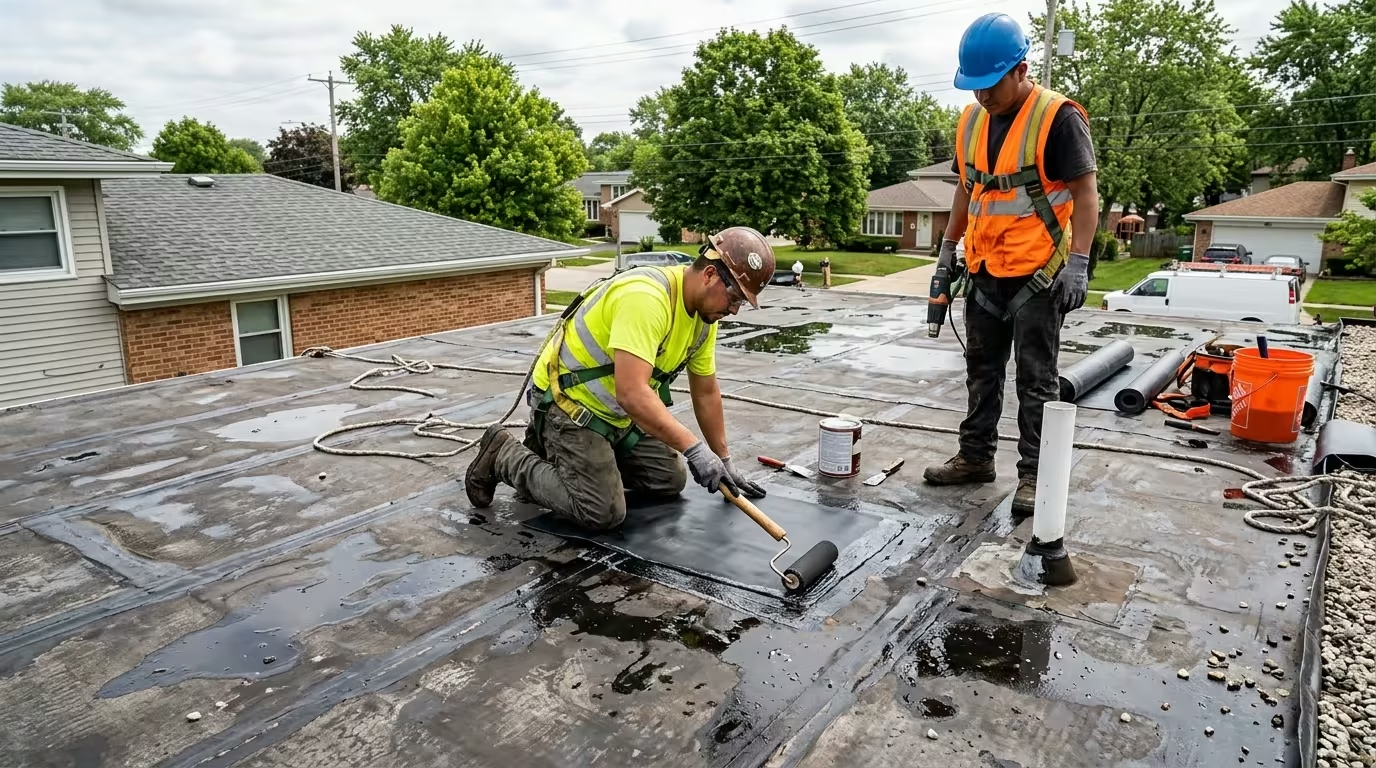
- Modified bitumen: Asphalt-based rolls, often torch-applied. Repairs with compatible mod-bit patch and mastic. Common on older Chicago-area flat roofs. Lasts 15–20 years.
- Built-up roofing (BUR): Layered tar and gravel. Old-school, heavy, durable. Repairs with hot asphalt or cold-process patching. Mostly found on older commercial buildings now.
If you don’t know your membrane type, a photo of the roof surface is usually enough for a professional to identify it — black and smooth is likely EPDM; white and smooth is likely TPO; granular or gravelly surface is mod-bit or BUR.
Repair or Replace? The Decision Framework
Repair it when:
– The membrane is under ~75% of its expected lifespan
– Leaks are isolated (1–2 spots) with a clear cause
– The deck underneath is solid
– Drainage can be corrected
Consider replacement or a full coating system when:
– Leaks keep recurring in different spots (systemic failure, not bad luck)
– The membrane is past its rated lifespan
– More than ~25% of the surface needs work
– The deck is saturated or sagging in multiple areas
– A coating/restoration system costs nearly as much as re-roofing
A silicone restoration coating can add 10–15 years to a structurally sound but aging membrane at a fraction of replacement cost — worth asking about if your roof is in that in-between zone.
Preventing the Next Flat Roof Leak
- Inspect twice a year (spring and fall) plus after major storms. Walk the roof — or have it walked — looking for punctures, open seams, and flashing gaps.
- Keep drains clear. The single highest-ROI maintenance task on a flat roof. Leaves, tennis balls, and debris in a drain cause more leaks than all other factors combined.
- Limit foot traffic and require anyone servicing rooftop equipment (HVAC techs) to use walkway pads.
- Address ponding within 48 hours. If water regularly stands longer, the slope or drainage needs correction — not just another patch.
- Recoat on schedule if you have a coated system — coatings are maintenance, not one-time fixes.
Frequently Asked Questions
How much does flat roof leak repair cost?
Isolated patches run $300–$800; flashing repairs $350–$900 per location; drainage corrections $150–$500 for clogs up to $1,500–$4,000+ for tapered insulation. Full coatings run $2–$5 per square foot.
Can you repair a flat roof in the rain?
No — membrane adhesives, primers, and welds all require dry conditions. Emergency tarping or interior containment handles the active leak; the real repair waits for dry weather. See our temporary roof repair guide, and if water is pouring in, our emergency roof leak repair.
How do I find a leak on a flat roof?
Start inside: the stain location, then check the roof uphill from it (water flows to low points). On the roof, look for punctures, open seams, cracked flashing, and ponding areas. Electronic leak detection (used by commercial pros) can pinpoint breaches in minutes on large roofs. Our step-by-step guide for tracing a leak covers the full process.
Is ponding water on a flat roof always a problem?
Water that drains within 24–48 hours is normal. Water that stands longer — or leaves dirt rings showing chronic ponding — accelerates membrane failure and will eventually leak. Fix the drainage, not just the membrane.
How long does a flat roof repair last?
A proper membrane patch or re-flash on a healthy roof lasts many years — often the remaining life of the membrane. A patch on a membrane that’s failing everywhere buys months. The repair is only as good as the roof around it.
Can a flat roof leak be fixed from the inside?
Only as containment (buckets, attic tarping). The waterproofing layer is on top — a lasting repair has to happen on the roof surface itself.
Flat roof leaking? Get it diagnosed properly.
Further Reading
- Family Handyman: Flat Roof Repair and Maintenance — flat-roof systems, leak causes, and repair methods
- This Old House: How to Find and Fix a Roof Leak — step-by-step leak-finding and repair walkthrough from a trusted home-improvement source
External links open in a new tab and are provided for reference; we are not affiliated with these publishers.
Roof leaking in Carol Stream? Get help fast.
Call Carol Stream Leak & Restoration at (630) 866-1445 — we'll connect you with a local repair professional serving Carol Stream, Bloomingdale, Glendale Heights, Wheaton, Hanover Park, Bartlett, and West Chicago.
Carol Stream Leak & Restoration is a local referral service that connects homeowners with independent local repair professionals; it is not a roofing contractor.