
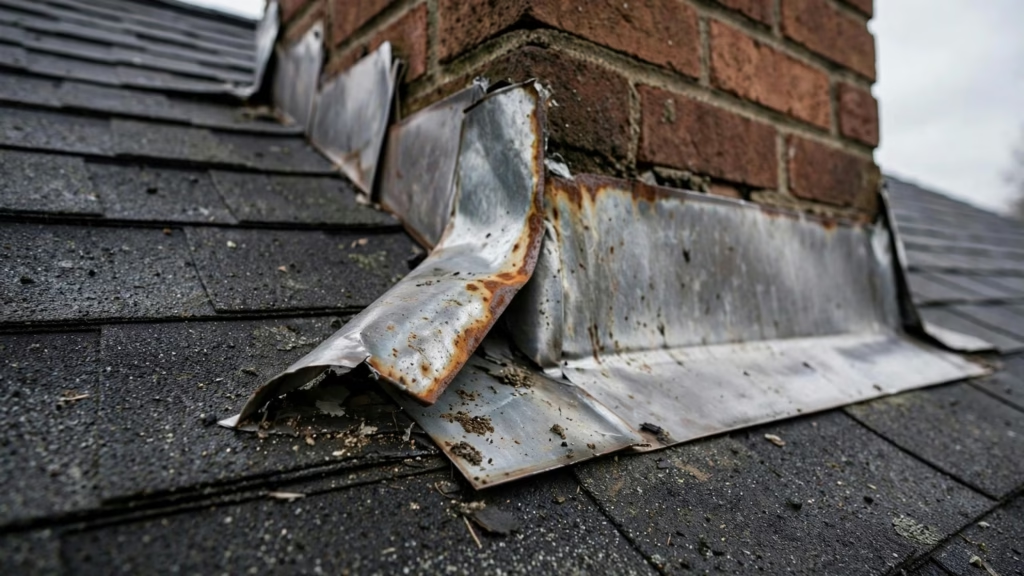
Shingles shed water on open slopes. Flashing handles the places where a slope ends or something pokes through it. It is the thin metal, usually steel or aluminum, that lines the edges of chimneys, skylights, walls, valleys, and vents. When flashing fails, water gets behind the shingles at exactly the spots that take the most runoff. That is why it is one of the first things a roofer checks on a leak call.
How flashing fails
- Sealant dries out. Many installations rely on caulk or roofing cement at the edges. Sun and temperature swings crack it over time.
- Metal loosens. Nails back out and edges lift, especially where the metal expands and contracts through hot summers and cold Illinois winters.
- Rust and corrosion. Steel flashing that loses its coating rusts through. Two different metals touching can speed that up.
- Poor installation. Flashing tucked under the wrong layer, or cut too short for the amount of water it carries, can leak from the start.
- Physical damage. Storms, falling branches, and ladders can bend it out of shape.
What a flashing leak looks like inside
The stain tends to sit along a wall, beside a chimney, or next to a skylight. Flashing leaks often need a good volume of water, so you may notice them in heavy rain and not in a light shower. Many homeowners go months seeing nothing, then get a stain after one hard storm. For a step-by-step method, read our guide on how to trace a roof leak to its source.
The main types, in plain terms
- Step flashing runs along a wall where the roof meets it. Small pieces are layered with each course of shingles.
- Counterflashing is a second piece, often set into the mortar of a chimney, that overlaps the first and keeps water from getting behind it.
- Valley flashing lines the low channel where two slopes meet.
- Drip edge sits along the eaves and rakes and guides water off the roof and away from the wood underneath.
Why caulk is not a fix
Roofing cement smeared over a gap often looks fine for a season. Then it cracks, and now an old layer of sealant hides the gap and holds water against it. A proper repair resets or replaces the flashing and laps it correctly with the shingles above and below. Sealant can back that up. It should not be the whole repair. See our guide on asphalt shingle roof leak repair for what a lasting repair involves.
What you can check yourself
Use binoculars from the ground. Look for gaps along walls and chimneys, lifted edges, rust streaks, and blobs of old sealant. Do not climb up to look. If you see any of these, write down where and take a photo.
Repair or replace
A small piece that has pulled loose can often be reset. Sections that have rusted through get replaced. If flashing is failing along a long run, it may make more sense to replace the whole run while the shingles beside it are open. A roofer can tell you which applies after looking at it in person.
Have your flashing checked
If you have a stain near a wall, chimney, or skylight, call Roof Leak Repair Carol Stream IL at (630) 866-1445. Tell us where the stain is and when you first saw it. For roof leak repair in Carol Stream, we can also check the surrounding shingles and underlayment.
Carol Stream Leak & Restoration is a free referral service. We connect Carol Stream homeowners with independent local roofing contractors — no fees to you, ever. Call (630) 866-1445 for fast help with a roof leak.