
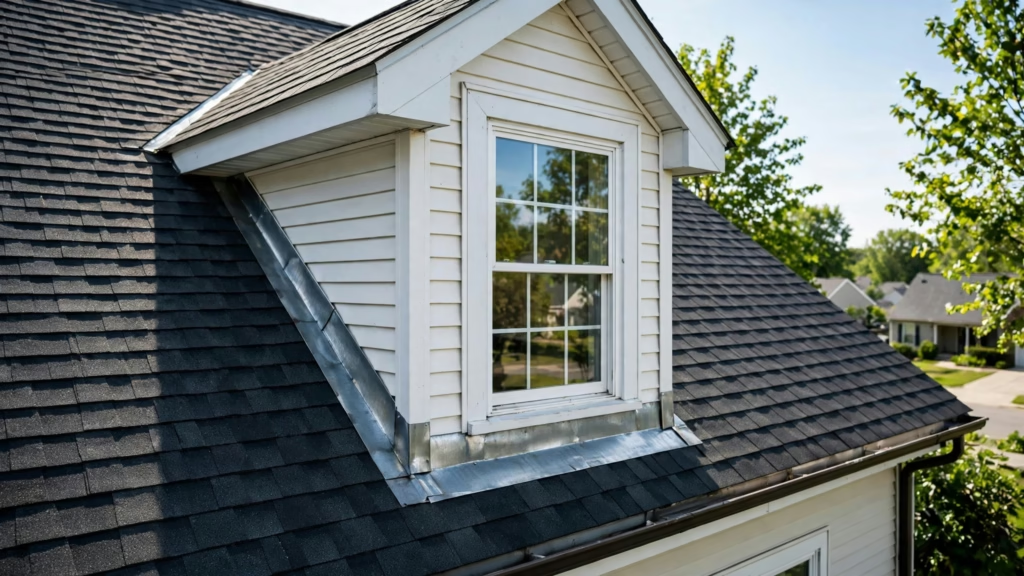
Most leaks do not begin in the middle of a clear slope. They begin at a joint, and one of the most common joints is where a roof meets a wall. That includes dormers, second-story walls that rise out of a lower roof, and additions built onto an older house.
Why these joints leak
The wall sheds water downward, and it lands on the roof. The roof then has to carry that water away without letting any of it get behind the wall. The joint between them depends on roof flashing, siding, and the way each layer overlaps the one below. If any layer is missing, cut short, or in the wrong order, water gets in.
What should be there
Where a sloped roof meets a vertical wall, the usual detail is step flashing. These are individual pieces of metal, each bent in an L shape, layered with each course of shingles. The roof side goes under the shingle, and the wall side goes up behind the siding or the house wrap. Water running down the wall lands on the flashing and is directed out onto the shingles.
Where a roof meets a wall at the bottom of a slope, a kick-out flashing diverts water into the gutter. Without it, water can run behind the siding and into the wall.
Common failures
- Missing or short kick-out flashing. Water runs behind the siding at the end of the roof edge, and the stain may show up in a wall or a ceiling below.
- Step flashing buried under siding or caulked instead of lapped. Caulk can hold for a time, but it is not a substitute for flashing.
- Siding too close to the roof. If siding sits on the shingles, water wicks up and rots the bottom edge.
- Additions tied in poorly. Where a new roof meets an old one, the flashing or the shingle layers may not have been lapped correctly.
- Dormer problems. A dormer has several joints: the cheeks, the front wall, the roof above, and the valleys on each side. Any one of them can fail.
Signs of a wall-to-roof leak
Look for stains near exterior walls, stains in the wall below the roofline, peeling paint, rotted trim or siding at the bottom edge, and water in the attic along the wall plate. These leaks often show up during wind-driven rain, much like skylight leaks.
What the repair involves
A proper roof leak repair often means removing a section of siding and shingles to see what is behind them, replacing or adding step flashing and kick-out flashing, and re-lapping the layers so water flows out. If wood has rotted, it should be replaced. Caulk alone on the surface rarely lasts.
Why a quick look is not enough
The problem may be hidden behind siding, and a leak may travel inside the wall before it shows. A roofer will check the flashing from the outside and the framing from the attic. If moisture has been inside a wall for a while, it may be worth checking the wall itself.
Get a joint checked
Call Roof Leak Repair Carol Stream IL at (630) 866-1445. Tell us where the stain is in relation to the walls and the roof.
Carol Stream Leak & Restoration is a free referral service. We connect Carol Stream homeowners with independent local roofing contractors — no fees to you, ever. Call (630) 866-1445 for fast help with a roof leak.