
Skylight Leaking? Causes & Repair Options
Few things ruin the charm of a skylight like water dripping through it onto your floor. Skylights are wonderful — natural light, a view of the sky, a sense of openness — but they’re also the most complex penetration on a typical roof. When a skylight leak repair is needed, the skylight itself is guilty far less often than the flashing around it.
This skylight leak repair guide walks through the condensation test, the real causes of skylight leaks, your repair options, and what each one costs.
Before anything else, one critical question: is it actually leaking? Up to a third of “skylight leaks” turn out to be condensation. This guide covers the condensation test, the real causes of skylight leaks, your repair options with costs, and how to decide between repair and replacement. If you’re still tracing the water’s origin, our roof leak detection guide walks through the full process.
First: Condensation or Real Leak? (The 2-Minute Test)
Skylights are condensation magnets. Warm, moist indoor air hits the cold glass (or the cold aluminum frame), and water forms — then drips. It looks exactly like a leak. Here’s how to tell:
It’s probably condensation if:
– The dripping happens in cold weather with no rain
– Water forms on the glass surface itself, or on the interior frame
– It happens mornings after showers, cooking, or heavy humidifier use
– You see fogging between… no wait, fogging between panes means a failed seal (see below), fogging on the room-side surface means condensation
It’s probably a real leak if:
– It happens during or right after rain, regardless of temperature
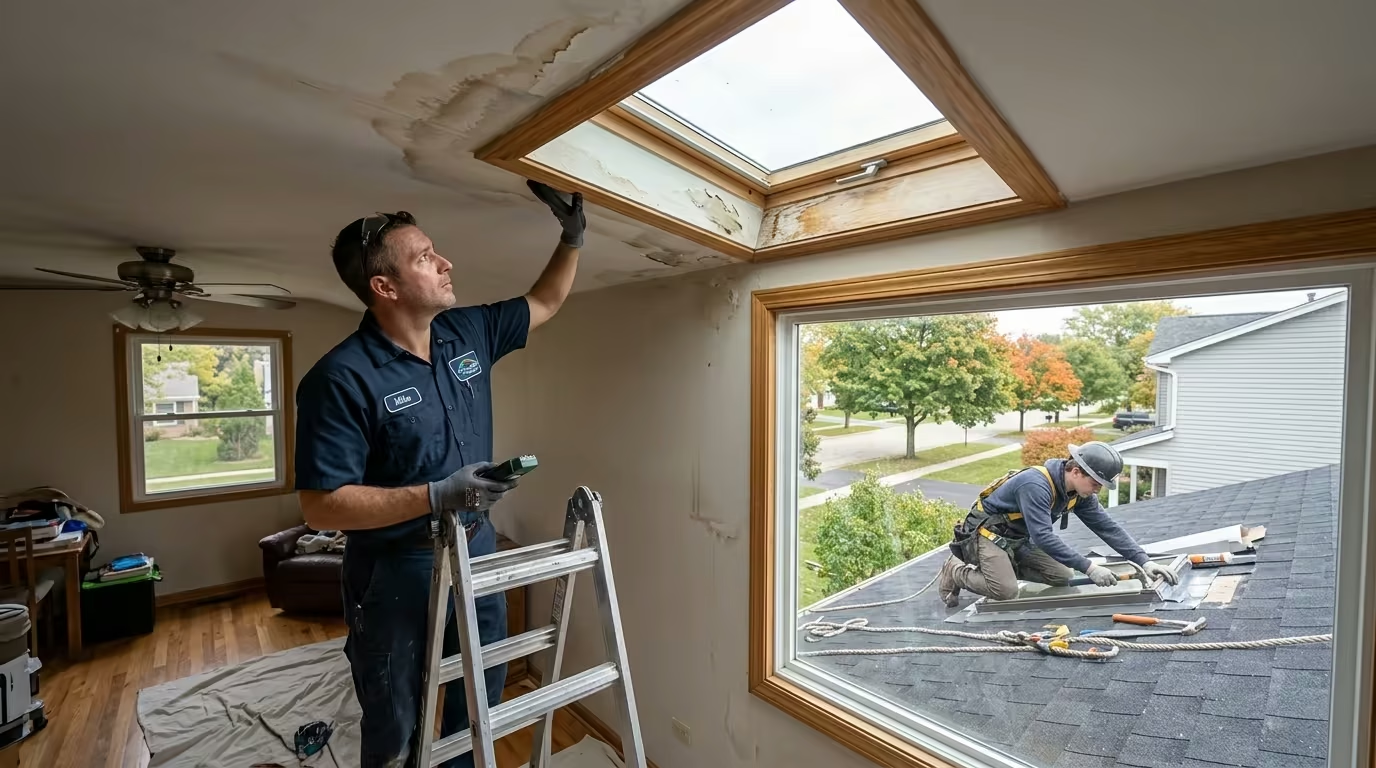
– Water comes from the frame edges, the drywall around the skylight shaft, or the ceiling — not the glass surface
– You see staining on the drywall shaft or the surrounding ceiling
Quick fix for condensation: Run bathroom/kitchen exhaust fans, keep indoor humidity under 40% in winter, and consider a skylight with better thermal performance when replacement time comes. If it’s condensation, no roof work is needed — save your money.
Skylight Leak Repair: The Real Causes of Skylight Leaks
1. Flashing Failure (The #1 Cause)
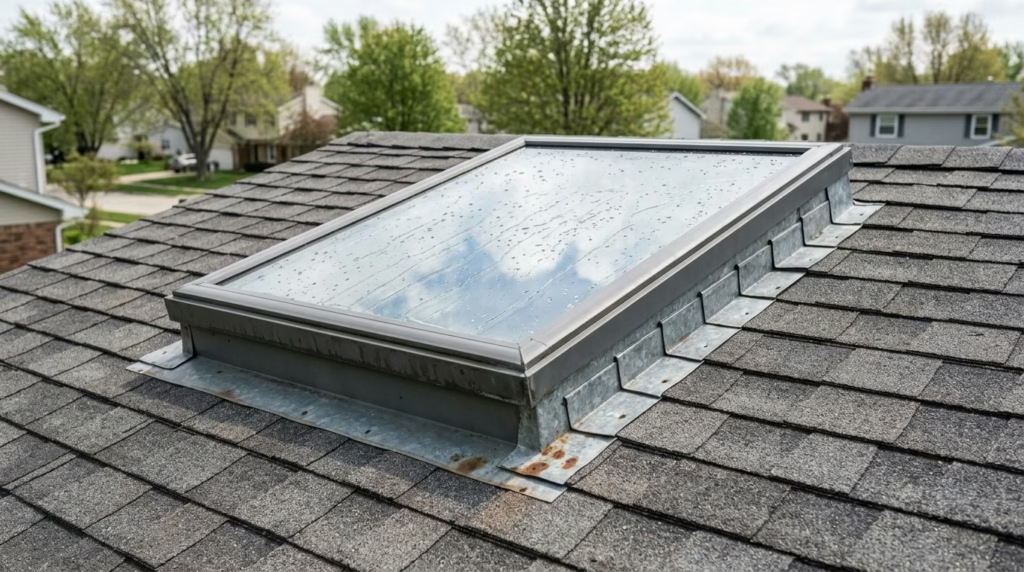
Skylight flashing is a multi-piece system: step flashing woven up the sides of the skylight curb, a head flashing across the top, and an apron flashing at the bottom. It has to integrate perfectly with the surrounding shingles or panels. When it fails — and it’s the most common skylight leak cause by a wide margin — water gets behind the system and into the curb.
Common flashing failures:
– Original installation shortcuts: flashing caulked instead of woven, pieces in the wrong order, or missing kickout flashing at the bottom
– Sealant breakdown at flashing joints after 10–15 years
– Curb shifting: the wooden curb the skylight sits on can settle or warp, opening gaps the flashing can’t bridge
– Re-roof damage: a previous roofer tore off around the skylight and didn’t rebuild the flashing properly
2. Skylight Seal and Gasket Failure
The skylight unit itself has seals: the gasket between the glass and frame, and the weep system that drains incidental water. After 15–20 years, gaskets shrink and harden. Symptoms: water appearing at the frame corners, or fog/moisture between the glass panes (that last one means the insulated glass unit’s seal has failed — the glass itself needs attention, not the roof).
3. Cracked Dome or Damaged Frame
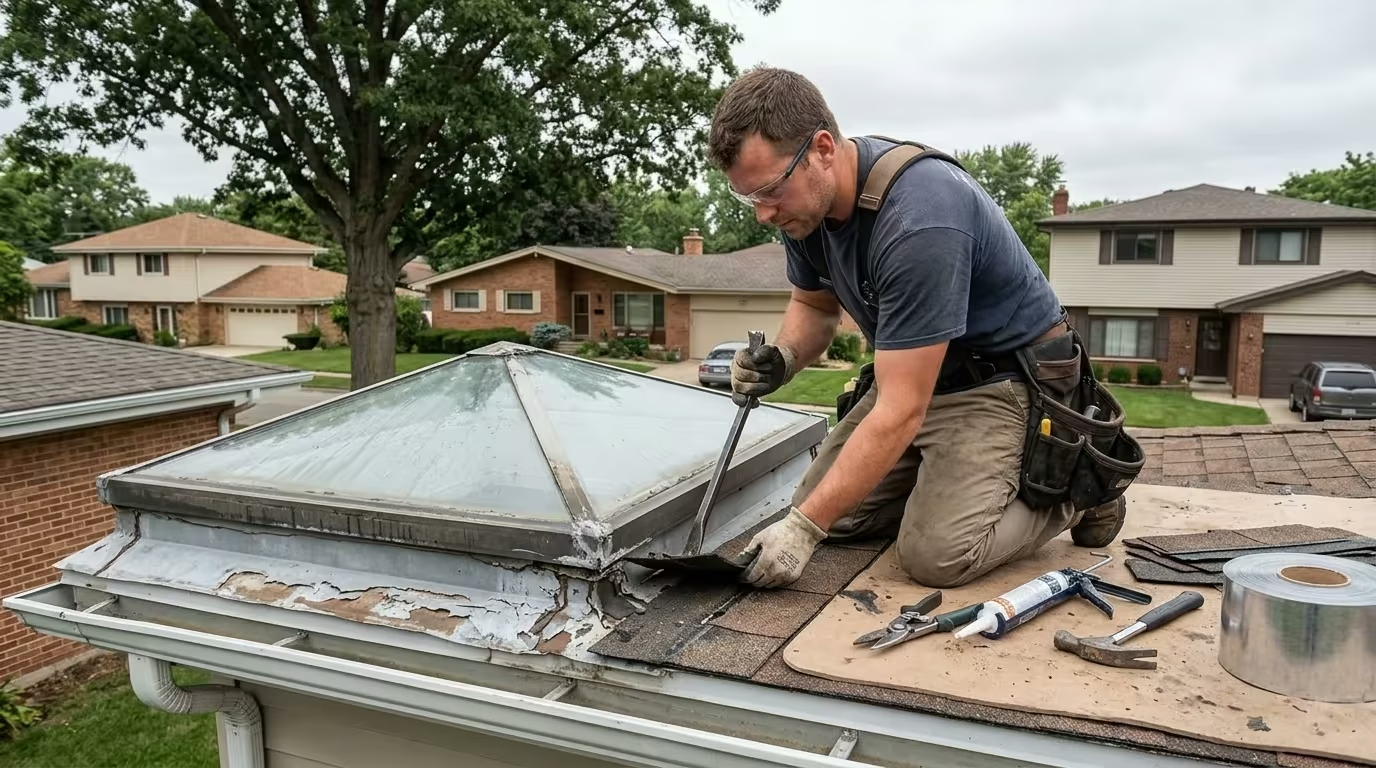
Acrylic dome skylights (common on older homes) become brittle with UV exposure and crack — from hail, falling branches, or just age. Aluminum frames can corrode at the corners. A cracked dome is a straightforward diagnosis: you can see it.
4. Ice Dam Backup
In Illinois winters, ice dams are a special skylight threat. Skylights sit in the field of the roof where ice builds up, and backed-up meltwater flows uphill under the flashing — a path flashing was never designed to resist. If your skylight only leaks in late winter during thaw cycles, suspect ice dam roof leaks rather than a flashing defect. Fixing the ice dam problem (insulation, ventilation) matters more than re-flashing.
5. Clogged Weep Holes
Quality skylights have weep holes that drain water collecting in the frame channel. Leaves, dirt, and insect nests clog them, and the channel overflows inward. A quick cleaning sometimes solves a “leak” completely — check this before spending money.
Skylight Leak Repair Options & Costs
| Repair | Typical cost range |
|---|---|
| Weep hole cleaning + reseal | $150 – $300 |
| Flashing reseal (sealant only) | $250 – $450 |
| Step flashing rebuild around existing skylight | $600 – $1,200 |
| Gasket/seal replacement | $300 – $600 |
| Glass unit replacement (fogged panes) | $400 – $800 |
| Full skylight replacement (same size, curb-mount) | $1,000 – $2,500 |
| Full replacement + new curb/flashing | $1,500 – $3,500 |
A few notes on these numbers:
- Resealing flashing with caulk is the cheapest option and the shortest-lived. It’s a reasonable emergency measure, not a permanent repair.
- A flashing rebuild — removing shingles around the skylight and installing a proper step-flashing system — is the correct permanent fix for flashing failures and lasts as long as the surrounding roof.
- Skylight replacement makes sense when the unit is 20+ years old, the glass seal has failed (fogging between panes), or the frame is damaged. Modern skylights are dramatically better sealed and more energy-efficient than 1990s–2000s units.
Repair vs. Replace: The Decision Framework
Repair the flashing when:
– The skylight unit itself is in good shape (clear glass, intact frame, under ~15 years old)
– The leak is clearly at the flashing/roof interface
– The curb is solid
Replace the skylight when:
– The glass seal has failed (permanent fogging between panes)
– The frame is cracked, corroded, or warped
– The dome is cracked or severely yellowed
– The unit is 20+ years old and you’re already paying for a flashing rebuild — the incremental cost of a new unit is small compared to doing the job twice
– You want to upgrade (venting skylights, better glazing, blinds)
One important nuance: if you’re re-roofing within the next few years, it often makes sense to replace an aging skylight during the re-roof. The flashing gets built fresh around the new unit in one coordinated job, which is both cheaper and more reliable than two separate projects. Mention the skylight’s age whenever you get roofing quotes.
What a Proper Skylight Flashing Repair Looks Like
- Shingles removed around all four sides of the skylight curb — typically 2–3 feet out.
- Curb inspected for rot or warping; damaged curbs get rebuilt.
- Ice-and-water shield applied around the curb (critical in Illinois — this self-sealing membrane is your backup against ice dam backup).
- New step flashing woven up both sides, head flashing at top, apron flashing at bottom — in the correct order, integrated with the shingles.
- Shingles reinstalled with proper overlap over the flashing.
- Hose test from above the skylight.
If a contractor proposes to “just caulk around it,” you’re buying months, not years. The full rebuild is the fix that holds.
Preventing Skylight Leaks
- Inspect annually. Look for cracked sealant, lifted flashing edges, and debris in the weep channels — add it to your roof leak prevention checklist routine.
- Keep the area clear. Branches overhanging a skylight drop debris that clogs weeps and, eventually, crack domes.
- Address attic humidity. Good ventilation and vapor control reduce the condensation that mimics leaks.
- Watch for ice dams. Skylights are ice-dam victims; proper attic insulation protects them.
- Know your skylight’s age. At 15 years, start budgeting; at 20, plan the replacement proactively rather than reacting to a leak.
If the leak has already damaged the ceiling or walls around the shaft, don’t stop at the roof — see our guide on roof leak water damage repair for the interior restoration steps.
FAQ
How much does it cost to fix a leaking skylight?
A simple reseal runs $250–$450; a proper flashing rebuild costs $600–$1,200. Full skylight replacement with new flashing runs $1,000–$3,500 depending on size, type (fixed vs. venting), and curb work needed.
Can a skylight be repaired, or does it always need replacement?
Most skylight leaks are flashing problems, and flashing can absolutely be repaired or rebuilt without replacing the skylight. Replacement is only necessary when the unit itself has failed — bad glass seals, cracked domes, damaged frames — or is simply past its useful life.
Why does my skylight leak only when it rains hard?
Wind-driven rain exploits marginal flashing that sheds normal rainfall fine. It can also overwhelm partially clogged weep holes — water enters the frame channel faster than it drains and overflows inward. Both are fixable without replacing the skylight.
Is a leaking skylight covered by homeowners insurance?
If the leak resulted from a sudden event (storm damage, fallen branch cracking the dome), likely yes. If it’s wear and tear, age, or installation defects, typically no. Document the damage with photos before any repair — insurers want to see the “before” state.
How long should a skylight last?
Quality skylights last 20–30 years, but the flashing and seals around them often need attention at 10–15 years. Acrylic domes degrade faster (10–15 years) than glass units. If your skylight is original to a 20+ year old roof, plan for replacement at the next re-roof.
Further Reading
- Family Handyman: 12 Tips for Finding and Fixing Roof Leaks — practical leak-detection tips for homeowners
- This Old House: How to Find and Fix a Roof Leak — step-by-step leak-finding and repair walkthrough from a trusted home-improvement source
External links open in a new tab and are provided for reference; we are not affiliated with these publishers.
Roof leaking in Carol Stream? Get help fast.
Call Carol Stream Leak & Restoration at (630) 866-1445 — we’ll connect you with a local repair professional serving Carol Stream, Bloomingdale, Glendale Heights, Wheaton, Hanover Park, Bartlett, and West Chicago.
Carol Stream Leak & Restoration is a local referral service that connects homeowners with independent local repair professionals; it is not a roofing contractor.