
Roof Leak After a Storm in Carol Stream: Hail & Wind Damage Guide
The sirens stop, the sky clears, and then you notice it — a brown stain blooming on the bedroom ceiling, or shingles scattered across the lawn. A storm damage roof leak rarely announces itself during the storm; it shows up hours or days later when water finally works through. In Carol Stream and the surrounding DuPage County suburbs, spring and summer bring hail, straight-line winds, and the occasional tornado — all of which can compromise a roof in ways you can’t see from the driveway.
This guide covers what Illinois storms do to roofs, how to spot the damage, what to do in the first 24 hours, and how to document everything for insurance and repairs. For our full storm damage roof repair service details, see the service page — this guide is your field manual for right now.
What Illinois Storms Do to Roofs
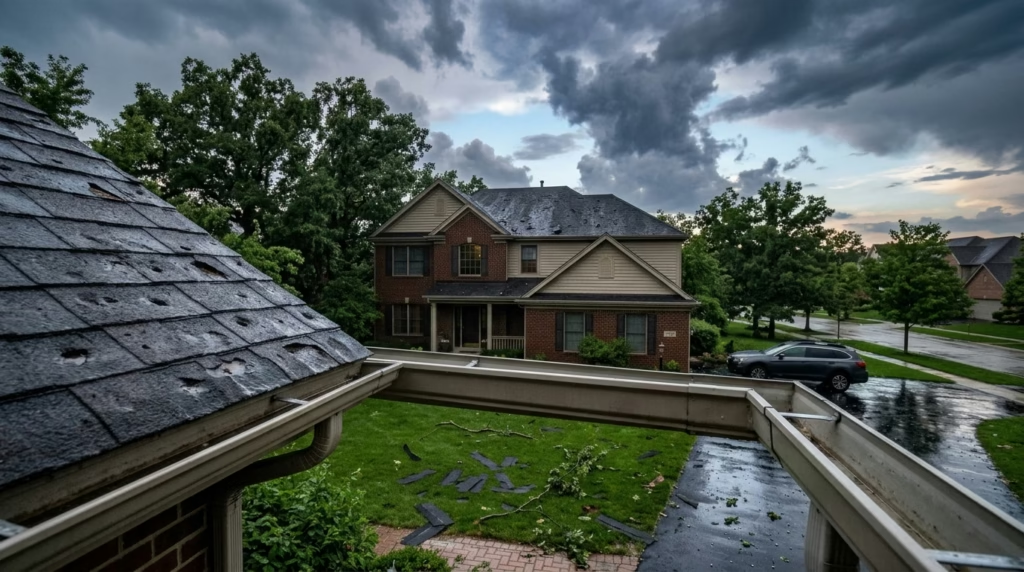
Hail. Even quarter-sized hail bruises asphalt shingles, knocking off the protective granules and cracking the fiberglass mat underneath. The damage is often invisible from the ground — the shingle looks fine until the bruised spot cracks open months later and leaks. Metal flashing, vents, and gutters dent visibly, which is your clue to look closer at the shingles.
Straight-line winds / derechos. Illinois gets powerful straight-line wind events (the August 2020 derecho tore across northern Illinois with 100+ mph gusts). Wind lifts shingle tabs, breaks their adhesive seals, and tears entire sections off — especially along ridges, eaves, and rakes. A lifted shingle may settle back down and look normal while its seal is broken, ready to leak in the next rain.
Tornadoes and microbursts. Less common but devastating — these remove whole roof sections and drive debris through decking.
Heavy rain alone. A wind-driven downpour can push water under already-aging flashing or through small gaps that never leaked in gentle rain. If your roof leaked only during the worst of the storm, suspect flashing or seal failures rather than missing shingles.
Hail vs. Wind Damage: How to Tell the Difference
Knowing which peril hit you matters — for your insurance claim and for the repair approach. Here’s how they differ:
| Sign | Hail damage | Wind damage |
|---|---|---|
| Pattern | Random dings across slopes, worse on windward side | Creased, lifted, or missing shingles along edges, ridges, eaves |
| Shingle look | Dark bruises, missing granule spots, cracked mat | Tabs folded back, broken seal strips, shingles in the yard |
| Flashing/gutters | Dented vents, gutters, downspouts | Usually undamaged unless debris hit |
| Leak timing | Often delayed — weeks or months later | Usually immediate — next rain after the storm |
| What to photograph | Close-ups of bruised shingles, dented metal | Lifted tabs, missing shingles, exposed underlayment |
Walk your property (from the ground — never climb up right after a storm) and photograph everything: shingles in the yard, dented gutters, debris impacts, and any interior stains. Date-stamp the photos. This documentation is the backbone of both your repair quote and any insurance claim.
Storm Damage Roof Leak: Your First-24-Hours Checklist
- Stay safe. Watch for downed power lines, hanging limbs, and structural damage. Don’t enter rooms with sagging ceilings.
- Do interior damage control. Buckets under drips, tarps over furniture, move valuables. If a ceiling is bulging, drain it with a small hole at the lowest point into a bucket.
- Cut power to wet areas. Water near fixtures or outlets means switching off that circuit’s breaker.
- Photograph everything — exterior damage from the ground, interior stains, damaged belongings. Wide shots for context, close-ups for detail.
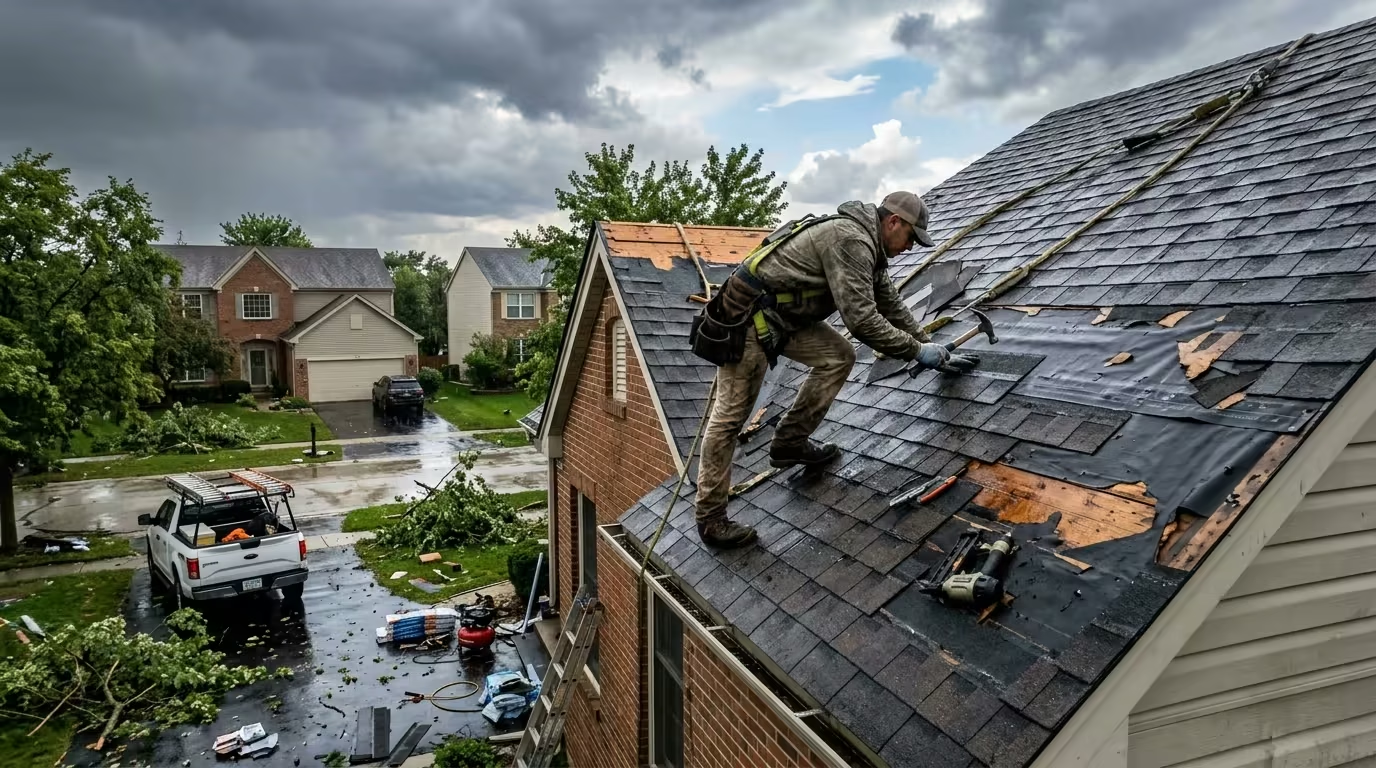
- Cover exposed areas. If shingles are missing and more rain is forecast, a secured tarp over the damaged section (from a ladder at the eave, only if safe) prevents the next storm from doubling your damage. This counts as a temporary roof repair — do it, then schedule the real fix.
- Call for professional help. An emergency roof leak repair service can tarp, assess, and document the damage properly — often the same visit.
- Notify your insurer once the immediate emergency is handled. Prompt reporting protects your claim.
What NOT to Do After a Storm
Storms attract a second disaster: storm chasers — out-of-area contractors who flood neighborhoods after hail events, knock on doors, and pressure homeowners into signing on the spot.
- Don’t sign anything at your door. No contingency contracts, no “free inspection” agreements with fine print assigning your insurance benefits. Legitimate local contractors don’t need high-pressure tactics.
- Don’t pay large upfront deposits. Reputable roofers take modest deposits or payment on milestones, not 50% cash before work starts.
- Don’t let anyone on your roof unsupervised. Some bad actors create damage to manufacture a claim. If someone’s up there, you or a trusted person watches.
- Don’t delay, either. Waiting months lets adjusters argue the damage is old. Get a local inspection within days, and learn the signs of roof leak damage so you can describe what you’re seeing accurately.
Work with established local professionals who have a physical presence in the area — they’ll still be here if a warranty issue comes up next year.
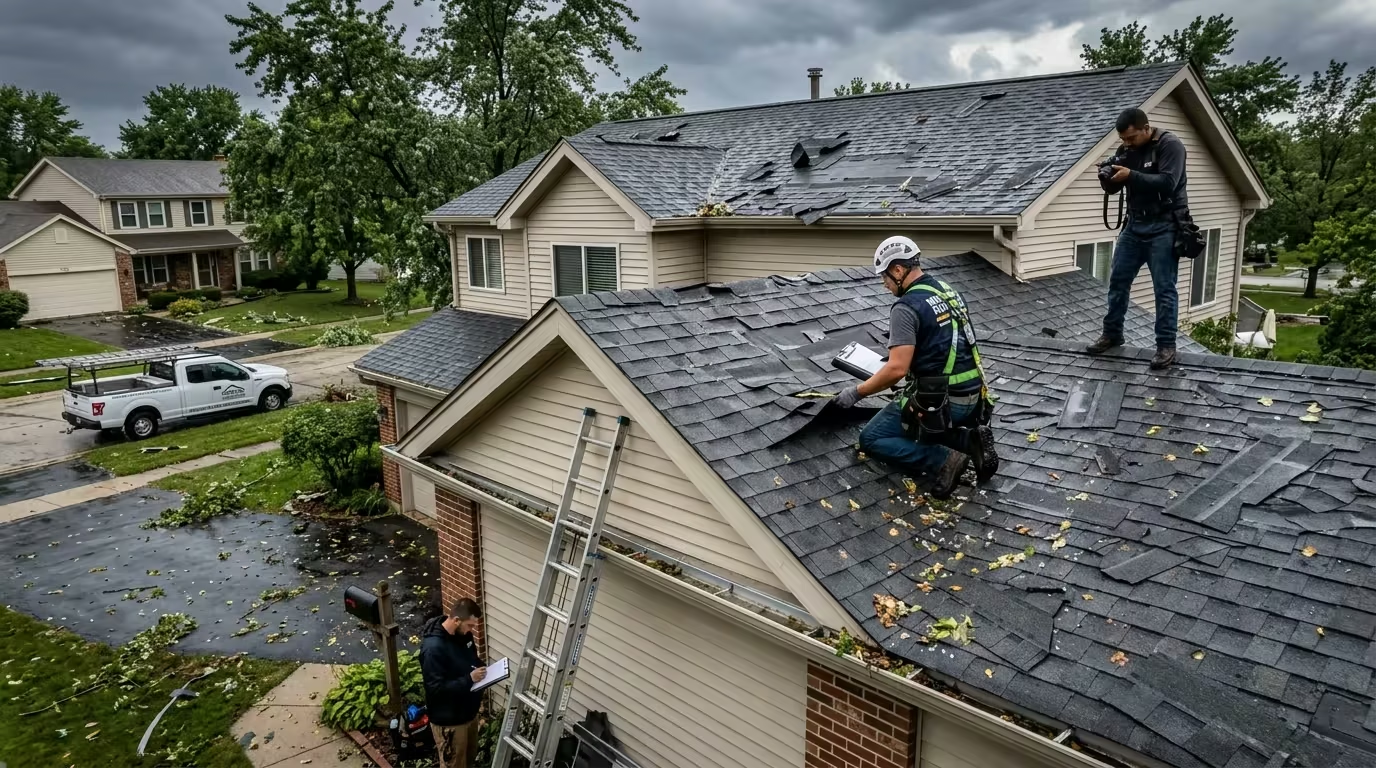
How Professionals Inspect Storm Damage
Knowing what a proper inspection looks like helps you judge the quality of whoever you hire:
- Ground-level survey of all slopes with binoculars or drone photos, noting damage patterns.
- On-roof inspection (by the pro, with safety gear): test squares marked in chalk to count hail bruises per 100 sq. ft. — the industry’s standard density measure.
- Flashing, vent, and gutter check — dented metal corroborates hail claims.
- Attic inspection for how to find a roof leak entry points: water trails on decking, wet insulation, daylight through holes.
- Written report with photos documenting the peril, the affected areas, and recommended scope — exactly what insurers and adjusters need.
If an “inspector” spends five minutes and hands you a contract, that’s a sales call, not an inspection.
Documenting for Insurance: What Adjusters Want
Your claim for a storm damage roof leak lives or dies on documentation. Adjusters look for:
- Date and event: Which storm? Note the date and, if you can, the National Weather Service reports for that day in DuPage County.
- Before-and-after evidence: Maintenance records and any older roof photos help prove the damage is new.
- The full scope: Interior stains, damaged belongings, exterior shingle/flashing/gutter damage — all photographed and dated.
- Mitigation proof: Receipts for tarps, emergency repairs, and any water damage roof repair work show you acted responsibly, which policies require.
- Independent estimates: Contractor quotes give the adjuster a reality check against their own estimate — and support a supplement if theirs comes in low.
For the full coverage breakdown — what’s covered, what’s excluded, deductibles — read our guide on whether homeowners insurance covers roof leaks.
Frequently Asked Questions
How soon after a storm should I inspect my roof?
As soon as it’s safe — ideally within 24–48 hours. Do a ground-level walkaround yourself immediately, then schedule a professional inspection within a week. Fast documentation protects both your home and any insurance claim.
My roof looks fine but my ceiling has a new stain. What happened?
Wind likely broke shingle seals or drove rain under aging flashing without visibly dislodging anything. Hail bruises can also take weeks to crack open. A stain after a storm with a “fine-looking” roof is common — get an on-roof inspection, because the damage is there, just not visible from the driveway.
Can I tarp my own roof after storm damage?
If you can do it safely from a ladder at the eave — dry conditions, stable ladder, a spotter — a tarp over the damaged area is a smart stopgap. Never walk a storm-damaged roof yourself; decking may be compromised and hidden hazards (nails, loose sections) are everywhere.
How do I know if hail damaged my roof?
Look for dented gutters, downspouts, and metal vents — if the metal is dented, the shingles took hits too. On the shingles themselves, look for dark spots where granules are missing. A professional hail inspection uses chalked test squares to count bruises per square, which is what insurers recognize.
Should I file an insurance claim for storm damage?
If a covered peril (hail, wind, fallen tree) caused the damage and repair costs clearly exceed your deductible, usually yes. Get a professional assessment first so you’re filing with evidence, not a hunch. Our insurance guide walks through the deductible math.
How long do I have to file a storm damage claim?
Most Illinois policies require “prompt” notice — practically, days to weeks, not months. Some policies have explicit one-year suit limitations. Don’t sit on it; delayed claims invite disputes about whether the damage is really from that storm.
Storm Hit Your Roof? Act Today.
Every day a storm-damaged roof sits open is another chance for water to get in. Get it tarped, get it inspected, get it documented — then get it fixed right.
Further Reading
- This Old House: Emergency Roof Leak Repair Costs & Safety — what counts as a roofing emergency and how to stay safe
- Family Handyman: 12 Tips for Finding and Fixing Roof Leaks — practical leak-detection tips for homeowners
External links open in a new tab and are provided for reference; we are not affiliated with these publishers.
Roof leaking in Carol Stream? Get help fast.
Call Carol Stream Leak & Restoration at (630) 866-1445 — we’ll connect you with a local repair professional serving Carol Stream, Bloomingdale, Glendale Heights, Wheaton, Hanover Park, Bartlett, and West Chicago. Related service: Storm Damage Roof Repair in Carol Stream, IL.
Carol Stream Leak & Restoration is a local referral service that connects homeowners with independent local repair professionals; it is not a roofing contractor.