
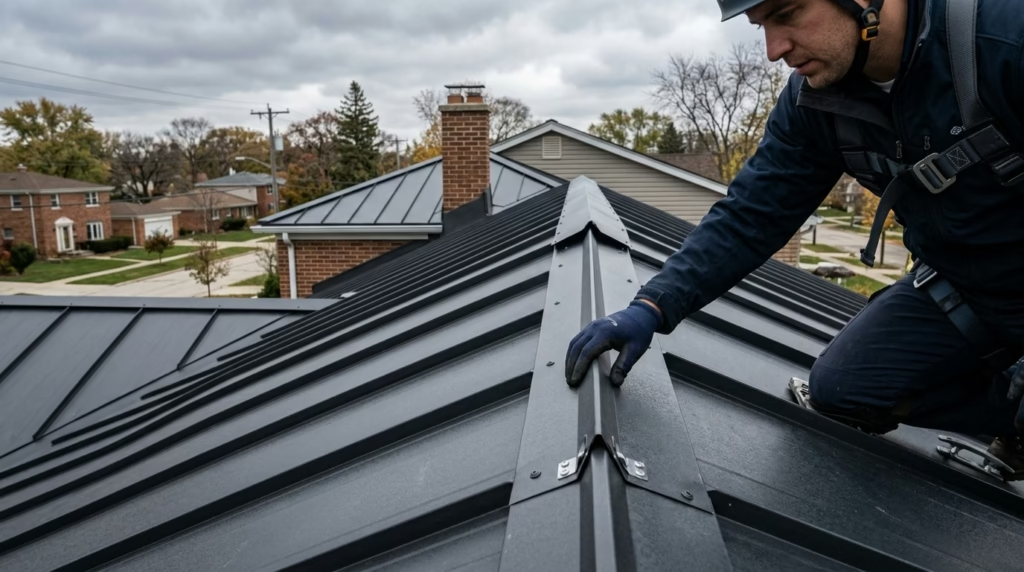
Metal Roof Leak Repair Guide
Metal roofs have a well-earned reputation for toughness — many carry 40- to 50-year warranties and shrug off hail, wind, and snow. So when water shows up on your ceiling anyway, it can feel like a betrayal. The good news: metal roof leak repair is usually simpler and cheaper than people expect, because the leak almost always starts at a specific failure point — a backed-out fastener, cracked sealant, or flashing that shifted — rather than the panels themselves.
If you’ve already run through how to find a roof leak and traced the water to a metal roof, this guide walks you through the most common causes, how repairs are actually done, what they cost, and when it’s smarter to replace panels instead of patching them. For Carol Stream homeowners, metal roofs are common on newer builds, garage additions, porches, and outbuildings — and Illinois freeze-thaw cycles are the single biggest thing working against them.
Why Metal Roofs Leak (It’s Rarely the Panel)
Metal panels don’t rot, curl, or lose granules the way asphalt shingles do. But they do expand and contract with temperature — a 20-foot steel panel can move a quarter inch or more between a January freeze and a July afternoon. That constant thermal cycling works on every fastener, seal, and flashing joint on the roof. Over time, something gives. Here are the culprits, in order of how often we see them.
1. Fastener Backout
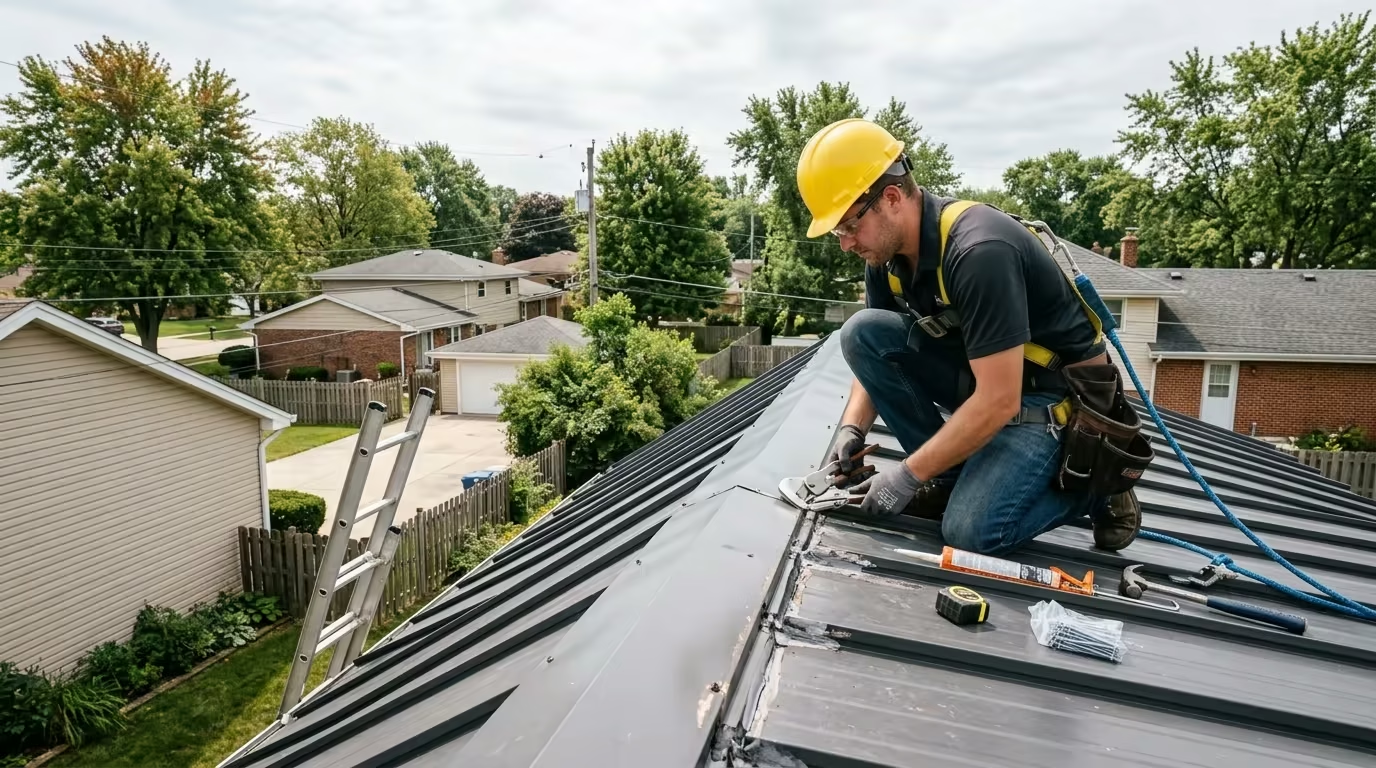
Exposed-fastener metal roofs (the kind with visible screws, common on garages, sheds, and budget-friendly installations) are the most leak-prone metal system. Each screw has a rubber neoprene washer that seals the hole. Thermal movement slowly walks screws loose — a process called fastener backout. When the washer lifts even slightly, water wicks down the screw shank into the roof deck.
Signs to look for:
– Screws that spin freely or sit tilted instead of flat
– Washers that look cracked, flattened, or missing entirely
– Rusty streaks radiating from screw heads
– Drips that appear during heavy rain but stop quickly after
The fix: A technician removes the loose fastener, checks whether the hole has elongated (if so, the panel may need a larger fastener or the hole gets sealed with butyl tape), and installs a new screw with a fresh EPDM washer. This is one of the most common and affordable metal roof repairs — and if several fasteners are backing out at once, it’s a sign the whole roof deserves a fastener audit rather than spot fixes.
2. Sealant and Caulk Failure
Every metal roof has joints where sealant does the waterproofing work: panel laps, end laps, flashing transitions, and around penetrations. The wrong sealant — or a sealant that’s simply reached the end of its 10- to 15-year life — dries, cracks, and pulls away.
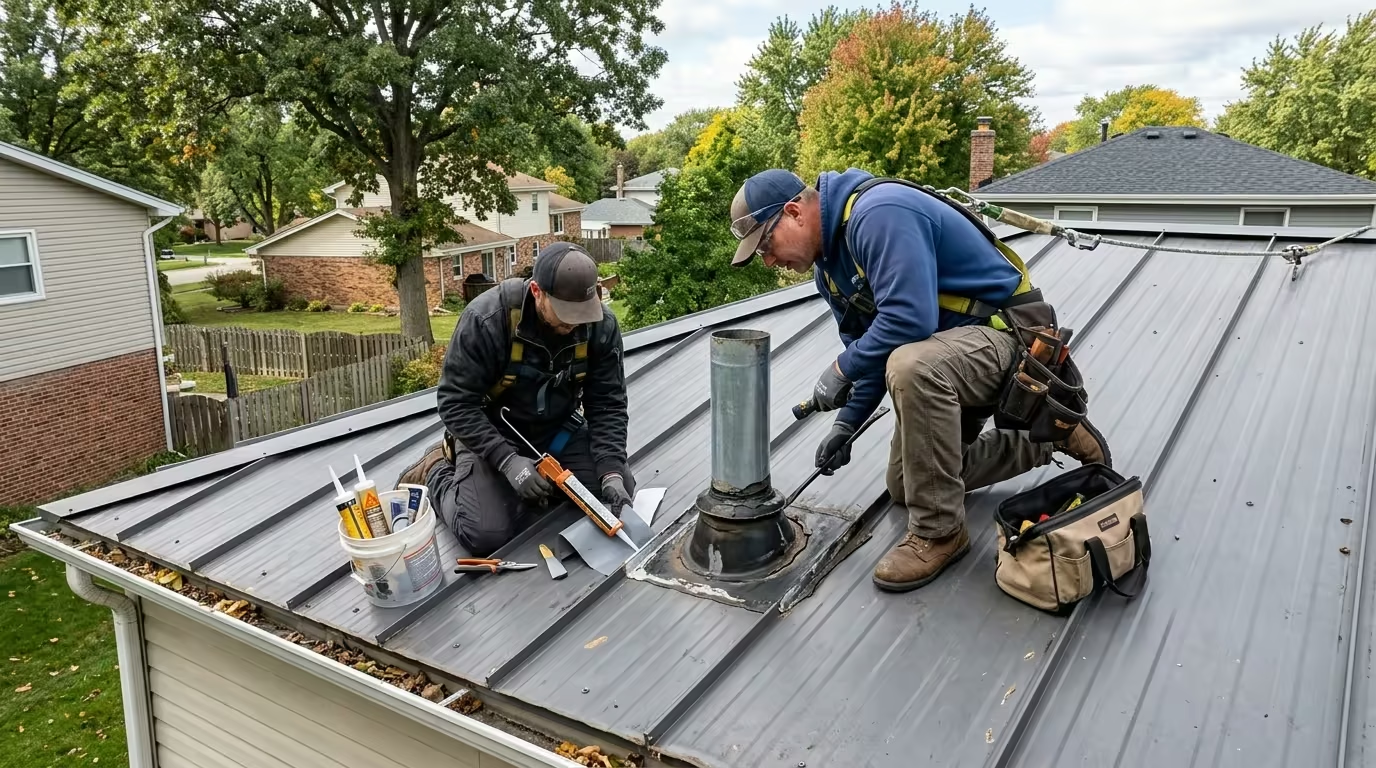
Cheap silicone and generic “roof caulk” from the hardware store fail fastest. Pros use butyl tape, polyurethane sealants, or tripolymer sealants rated for metal movement and UV exposure. A repair involves scraping out the failed material down to clean metal, laying fresh sealant in the manufacturer’s recommended bead size, and sometimes adding a cover flashing over the joint.
3. Rust and Corrosion
Galvanized and galvalume steel panels resist rust for decades — until the protective coating is damaged. Scratch it during installation, cut a panel with the wrong blade, let leaves sit and hold moisture against it, and corrosion starts. Fastener heads rust first, then the panel edges and lap joints.
Minor surface rust gets cleaned, treated with a rust converter or zinc primer, and top-coated. If the corrosion has eaten through the panel (you can poke a screwdriver through it), that panel needs replacement — patching thin corroded metal is a temporary measure at best.
4. Flashing Failures at Penetrations
Chimneys, skylights, vents, and plumbing stacks are where metal roofs meet other materials — and where leaks love to start. Counter-flashing separates from masonry, roof vent flashing seals dry out and crack, and skylight curbs shift as the roof moves beneath them. If your drip is near a chimney or vent, start your inspection there before suspecting the panels.
5. Expansion and Contraction Damage
On long panels, thermal movement is a force, not a suggestion. If an installer didn’t allow for it — screws over-torqued, no slotted fastener holes on floating clips, end laps too tight — the panels bind and the stress concentrates at the fasteners and seams. The result: cracked sealant, torn butyl tape, and elongated fastener holes. Repairs here sometimes require reworking a whole run of panels rather than a single joint.
6. Standing Seam Specific Issues
Concealed-fastener standing seam systems leak less often, but when they do it’s usually:
– Seam clips that were mis-set, letting the seam “walk” open
– Damaged seam caps from foot traffic or falling branches
– Failed factory-applied sealant inside the seam (rare, but it happens after 20+ years)
These require a specialist with a seaming tool — not a caulk gun.
How Metal Roof Leak Repair Actually Works
A proper repair follows the same sequence whether it’s a $150 fastener job or a $2,000 flashing rebuild:
- Locate the true entry point. Water on a metal roof runs downhill inside the panel system and can exit the ceiling far from where it entered. Tracing a leak means checking the uphill side of the stain — sometimes signs of a leak inside your home show up one or two panel runs away from the actual breach.
- Identify the failure. Is it a mechanical issue (loose fastener, shifted flashing), a material issue (cracked washer, failed sealant), or corrosion?
- Remove failed material. Old sealant, rust scale, and debris get stripped so the repair bonds to clean metal.
- Apply the repair. New fastener with fresh washer, new butyl-backed flashing, new sealant bead — matched to the roof system, not generic.
- Water-test. A controlled hose test from the uphill side confirms the fix before anyone leaves.
The most common homeowner mistake is skipping straight to step 4 — smearing silicone over the visible stain area. On metal, that traps moisture behind the sealant and accelerates corrosion. If you’re going to DIY anything, DIY the diagnosis; leave the sealant choice to someone who knows which products are compatible with your panel coating (some sealants damage Kynar finishes).
Metal Roof Leak Repair Costs
Prices vary by roof system and access, but these Carol Stream-area ranges are realistic for 2026:
| Repair | Typical cost range |
|---|---|
| Fastener replacement / re-seating (per area) | $200 – $450 |
| Sealant refresh at laps and joints | $300 – $750 |
| Pipe boot or vent flashing replacement | $350 – $650 |
| Chimney counter-flashing rework | $750 – $1,500 |
| Panel replacement (per panel) | $400 – $900 |
| Rust treatment and coating (per section) | $500 – $1,200 |
| Full fastener audit + re-seat (whole roof) | $1,500 – $3,500 |
Factors that push costs up: steep pitch, multi-story access, standing seam systems (specialized labor), snow or ice on the roof, and corrosion that spread beyond one panel. A reputable tech will show you photos of the failure point before quoting — ask for them.
Repair vs. Replace: Making the Call
Here’s the decision framework we recommend for metal roofs:
Repair it when:
– The leak is at one or two isolated points (fasteners, one boot, one flashing)
– Panels are under 20 years old with intact coating
– Rust is cosmetic surface rust, not pitting
– The underlying deck is solid
Replace panels (or sections) when:
– Fastener holes are elongated across large areas
– Corrosion has pitted through multiple panels
– The coating is failing system-wide (chalking, peeling)
– You’ve repaired the same joint twice and it keeps failing — the underlying movement issue needs addressing, not another bead of sealant
Replace the whole roof when:
– The roof is 30+ years old on an exposed-fastener system with widespread corrosion
– Panel seams are opening across multiple slopes
– Repair costs approach 40–50% of replacement cost
If you’re weighing asphalt shingle roof leak repair versus switching to metal entirely, that’s a different conversation — but if you already own a metal roof, repairing a sound system almost always beats replacing it.
Preventing the Next Metal Roof Leak
- Annual fastener check. Walk the roof (or have someone do it) every fall; re-seat anything that’s backed out before winter.
- Keep it clean. Leaves and debris hold moisture against panels and accelerate coating failure.
- Watch the valleys. Metal valleys collect granules from neighboring shingle roofs and debris; keep them clear so water doesn’t back up under panel laps.
- Don’t mix metals. Copper, aluminum, and steel in contact with each other (plus water) create galvanic corrosion. If a repair introduces a new metal, it must be isolated.
- Recoat on schedule. Exposed-fastener roofs benefit from a recoat every 10–15 years — far cheaper than panel replacement.
See our full 12-point roof leak prevention checklist for the seasonal routine that works across all roof types.
FAQ
Can I just caulk a metal roof leak myself?
You can, but metal roofs punish generic caulk. Standard silicone doesn’t bond well to many panel coatings and can’t flex with thermal movement, so it fails within a season or two — often trapping water behind it. If you must DIY a temporary patch, use a polyurethane or tripolymer sealant labeled for metal roofing, and plan a permanent repair within the year.
Why does my metal roof only leak in heavy rain?
Light rain may not produce enough volume to find the entry point, or wind-driven rain may push water under a marginal flashing lap that sheds water fine in calm conditions. This is classic for fastener backout and cracked washers — the leak needs volume plus pressure.
Is a leaking metal roof covered by warranty?
Possibly, but it depends on the warranty type. Manufacturer warranties cover panel defects and coating failure, not installation errors — and most leaks trace to installation or maintenance issues, which fall under the installer’s workmanship warranty (usually 5–10 years). Check your paperwork before paying out of pocket.
How long do metal roof repairs last?
A properly done fastener or flashing repair lasts as long as the materials involved — typically 10–15 years for sealants, the life of the roof for a correctly installed flashing. A smeared-caulk patch might last one season. The difference is preparation and material choice, not effort.
Do I need to replace my metal roof if one panel leaks?
Almost never. Isolated panel damage — one corroded section, one impact dent — gets fixed with a single panel replacement. Whole-roof replacement is only warranted when the system is failing across the board, which usually takes 30+ years on a properly installed metal roof.
Further Reading
- Family Handyman: 10 Roof Problems and What to Do About Them — common roofing problems and their fixes
- This Old House: How to Find and Fix a Roof Leak — step-by-step leak-finding and repair walkthrough from a trusted home-improvement source
External links open in a new tab and are provided for reference; we are not affiliated with these publishers.
Roof leaking in Carol Stream? Get help fast.
Call Carol Stream Leak & Restoration at (630) 866-1445 — we’ll connect you with a local repair professional serving Carol Stream, Bloomingdale, Glendale Heights, Wheaton, Hanover Park, Bartlett, and West Chicago.
Carol Stream Leak & Restoration is a local referral service that connects homeowners with independent local repair professionals; it is not a roofing contractor.