
Roof Leak vs Plumbing Leak: How to Tell the Difference in 2 Minutes
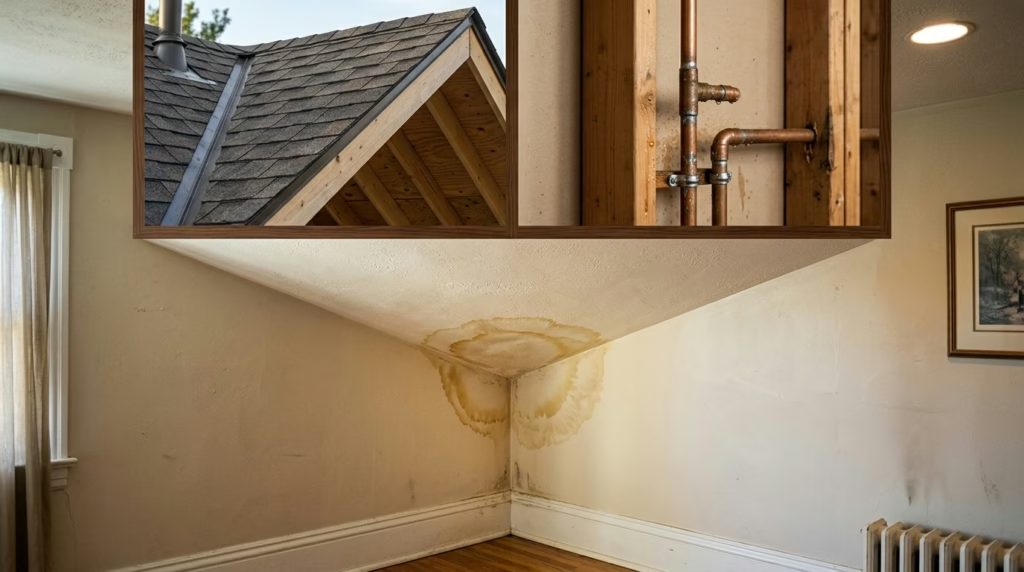
A brown stain is spreading across your ceiling. Is it the roof or the plumbing? Guessing wrong is expensive: calling a roofer for a plumbing problem — or a plumber for a roof problem — wastes the service-call fee and delays the real fix while water keeps working. This roof leak vs plumbing leak guide gives you a fast, reliable way to tell the difference before you pick up the phone.
You don’t need special tools. You need two minutes, your eyes, and answers to four simple questions. Let’s walk through them.
The 2-Minute Diagnostic Checklist
Run these four tests in order. In most cases, the first two give you a confident answer.
Test 1: Timing — Does It Follow Rain?
This is the single most reliable test.
- Wet during or within 24 hours of rain? → Almost certainly a roof leak. Rain is the only water source that fits.
- Wet on a dry day, with no rain in the past few days? → Almost certainly plumbing (or HVAC condensation). The roof can’t leak without rain.
Check the stain with a paper towel or your fingertip. If you live in Carol Stream, also think about snow: a stain that appears as snow melts off the roof in winter points to the roof — specifically, to an ice dam roof leak.
One caveat: a slow roof leak can keep dripping for a day or two after rain stops, because soaked insulation and wood release water gradually. Give it 48 dry hours before ruling out the roof.
Test 2: Location — Where Is the Stain?
Location narrows it dramatically.
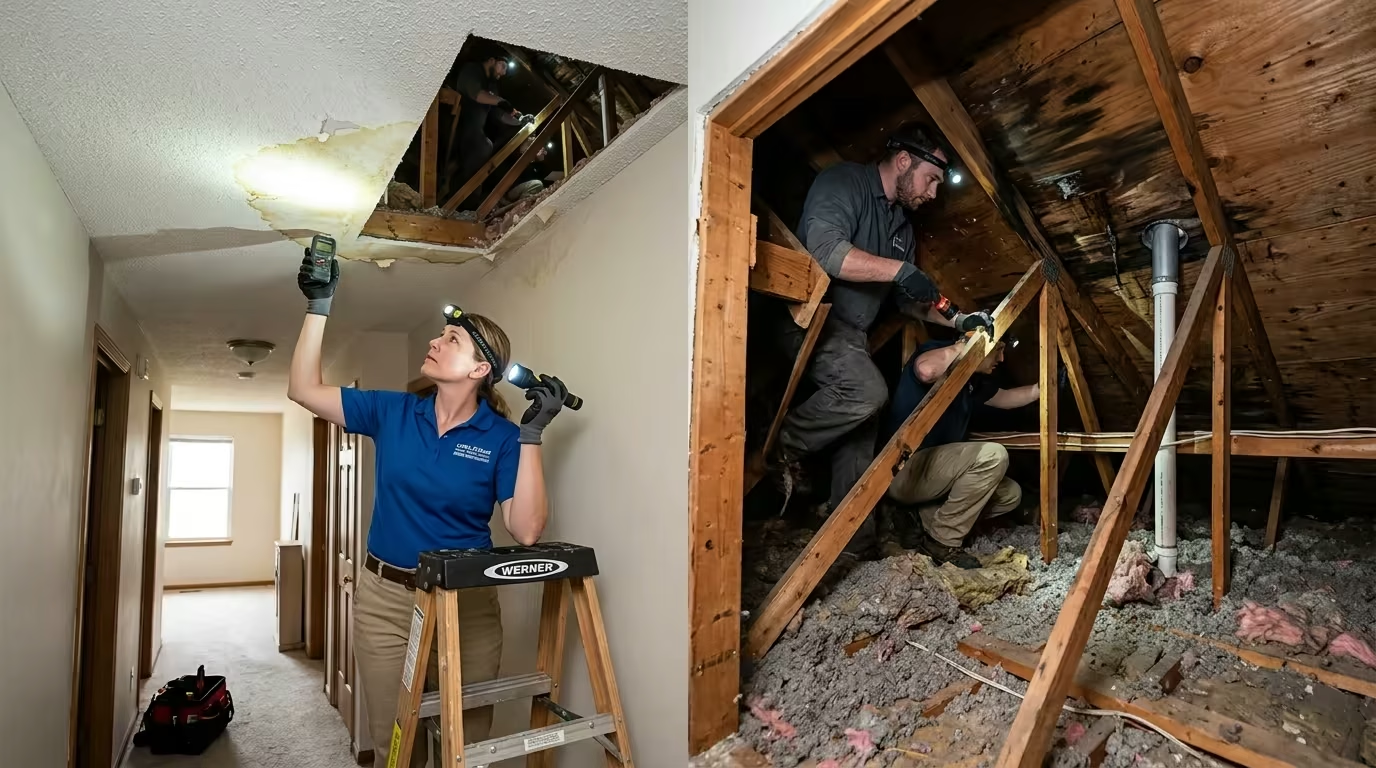
- Stain is on the top floor ceiling, directly below the roof, with no bathroom or kitchen above it? → Likely a roof leak. Learn how to find a roof leak to trace it to the source.
- Stain is directly below a bathroom, kitchen, or laundry room? → Likely plumbing. Supply lines, drain lines, shower pans, and toilet seals all fail.
- Stain is on a wall rather than a ceiling? → Plumbing running inside the wall is a strong suspect, though wind-driven rain through failed siding or window flashing can also stain walls.
- Stain is in the middle of a large open room with plumbing nowhere nearby? → Points to the roof — water travels along rafters and drops where it finds a seam.
Also note the stain’s shape. Roof leaks often create stains that grow, fade, and grow again with each rain — an expanding-and-drying cycle. Plumbing leaks tend to grow steadily, rain or shine.
Test 3: Water Color and Smell
If the stain is actively wet, examine the water itself.
| Observation | Points To | Why |
|---|---|---|
| Clear to tea-brown, no smell | Roof leak | Rainwater picking up color from wood, shingles, and dust |
| Yellowish or foul-smelling | Plumbing (drain/sewer) | Drain water carries waste |
| Soapy or with residue | Plumbing (supply/drain) | Dishwasher, washing machine, or sink lines |
| Dark, gritty, or tarry | Roof leak | Asphalt shingle granules and roofing tar wash down with rain |
| White mineral crust around the stain | Either, but often plumbing | Hard-water deposits from a slow supply-line drip |
Test 4: The Water Meter Test (for Suspected Plumbing)
If tests 1–3 are inconclusive and you suspect plumbing, this settles it:
- Turn off every water-using fixture and appliance (faucets, dishwasher, washing machine, ice maker).
- Find your water meter — usually in the basement, crawlspace, or a pit near the street.
- Watch the meter’s flow indicator (the small spinning triangle or dial) for 10–15 minutes.
- If it moves with everything off, water is flowing somewhere it shouldn’t — you have a plumbing leak, possibly inside a wall or ceiling.
If the meter is dead still and the stain only wets up after rain, it’s the roof. Case closed.
Quick-Reference Comparison Table
| Clue | Roof Leak | Plumbing Leak |
|---|---|---|
| Timing | During/after rain or snowmelt | Any time, rain or shine |
| Location | Top floor, often away from bathrooms | Below or beside bathrooms, kitchens, laundry |
| Growth pattern | Expands with storms, dries between | Steady growth regardless of weather |
| Water appearance | Clear to brown, sometimes gritty | May be discolored, soapy, or odorous |
| Attic evidence | Wet roof deck, stains on rafters | Dry roof deck; wetness around pipes only |
| Water meter (all fixtures off) | Still | May show flow |
Roof Leak vs Plumbing Leak: Tricky Cases That Fool Homeowners
Even with the checklist, a few situations blur the lines. Here’s how to read them:
“The stain is wet on a dry day, but we had rain three days ago”
A soaked roof deck and saturated insulation can drip for 48–72 hours after a heavy storm. If the weather has been dry for more than three days and it’s still wet, shift your suspicion to plumbing.
Condensation mimicking a leak
In winter, warm moist air from the house hitting a cold attic can condense on nails and drip — looking exactly like a roof leak on a dry day. Clues: tiny drip marks scattered widely rather than one defined stain, frost on the underside of the deck, and no rain correlation. The fix is ventilation and air sealing, not roofing.
HVAC condensate lines
Air conditioners and high-efficiency furnaces produce condensate that drains through PVC lines — often routed through ceilings and attics. A clogged or disconnected condensate line drips exactly like a plumbing or roof leak, and it runs whenever the system runs. Check your condensate drain line and pan before calling anyone.
A plumbing vent through the roof
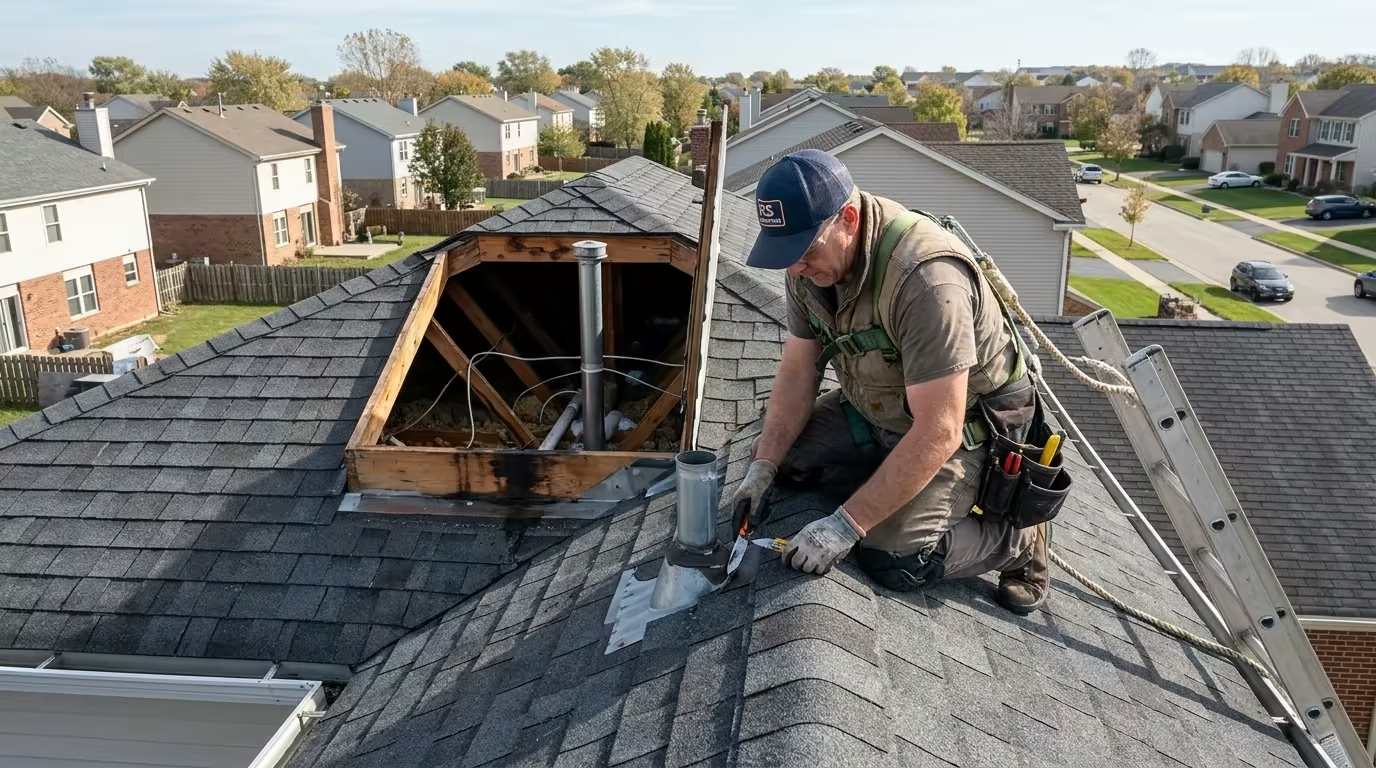
Here’s the overlap case: the pipe that vents your plumbing pokes through the roof, and the rubber boot sealing it fails. Is that a roof leak or a plumbing leak? Functionally it’s a roof leak — rainwater entering around the pipe — and a roofer fixes it. See our guide to roof vent leak repair.
Skylight leaks
Dampness around a skylight is almost always failed flashing or seals — a roofing issue, not plumbing — even when the water appears far from any rain event (a slow skylight leak can drip for days after storms). Details in our skylight leak repair guide.
What NOT to Do While You Diagnose
- Don’t poke or enlarge the stain to “see better.” You can release trapped water suddenly and damage more ceiling.
- Don’t ignore it because it dried up. Stains that dry between rains are still active leaks; the damage continues with every storm.
- Don’t call the wrong trade twice. Run the four tests first — a confident diagnosis saves you a wasted service call.
- Don’t delay containment. If it’s actively dripping, put a bucket under it and move valuables regardless of the cause.
If you suspect the roof after all, the next step is tracing it precisely using the attic method above — or calling a professional who can confirm it for you.
When It’s the Roof: Next Steps
Once your tests point to the roof:
- Check the attic for the stain trail and mark the entry area.
- Note the signs of roof leak inside your home — photograph everything for insurance purposes.
- Contain the drip with a bucket; relieve a bulging ceiling by draining it at its lowest point.
- Prevent recurrence — once repaired, follow our how to prevent roof leaks so you’re not diagnosing the same problem next spring.
Water damage from a roof leak can lead to mold, rotted framing, and ruined insulation fast — so it’s worth understanding what professional water-damage repair involves before you need it.
Frequently Asked Questions
Can a roof leak happen without rain?
Not from rain, by definition — but roof-related water entry can happen without rain in two cases: melting snow feeding an ice dam in winter, and condensation in a poorly ventilated attic dripping off cold surfaces. Both are roof-system problems even on dry days. True plumbing leaks, of course, run on any schedule.
My ceiling stain is right below the upstairs bathroom. Could it still be the roof?
It’s possible but unlikely. Water from a roof entry uphill of the bathroom can travel along joists and drop below the bathroom — but the odds favor plumbing. Do the rain-timing test: if it only wets after storms, get the roof checked; if it’s wet on dry days, call a plumber first.
How fast should I act once I know it’s a roof leak?
Immediately contain the drip, then get it assessed within days, not weeks. Every rain event expands the damaged area — stained drywall becomes sagging drywall, then mold, then rotted decking. A small flashing repair caught early costs a fraction of a repair that waits a season.
Will homeowners insurance cover the repair?
Insurance typically covers sudden, accidental water damage (the ruined ceiling, flooring) but not the roof repair itself if it resulted from wear and tear or deferred maintenance. Document everything with photos and dates, and review your policy’s water-damage exclusions before filing.
Should I call a roofer or a plumber first if I’m not sure?
Run the 2-minute tests above — they’re designed to answer exactly this. If still unsure after all four tests, start with whichever your evidence leans toward, and tell the contractor what you’ve observed. An honest pro will tell you if the problem is outside their trade rather than selling you a repair you don’t need.
Not Sure Which Leak You Have? Get a Local Pro to Confirm
Further Reading
- This Old House: How to Find and Fix a Roof Leak — step-by-step leak-finding and repair walkthrough from a trusted home-improvement source
- Family Handyman: 10 Roof Problems and What to Do About Them — common roofing problems and their fixes
External links open in a new tab and are provided for reference; we are not affiliated with these publishers.
Roof leaking in Carol Stream? Get help fast.
Call Carol Stream Leak & Restoration at (630) 866-1445 — we’ll connect you with a local repair professional serving Carol Stream, Bloomingdale, Glendale Heights, Wheaton, Hanover Park, Bartlett, and West Chicago.
Carol Stream Leak & Restoration is a local referral service that connects homeowners with independent local repair professionals; it is not a roofing contractor.