
Roof Leak Water Damage: Repair, Costs & What to Do First
The drip is only half the problem. By the time water shows up on your ceiling, it’s already traveled through insulation, decking, and drywall — and every hour it keeps coming, the damage (and the bill) grows. This guide covers water damage roof repair from the inside out: what to do in the first hour, how to document for insurance, the drying and mold timeline, and realistic repair costs for ceilings, drywall, and everything the water touched.
This water damage roof repair guide covers the first-hour checklist, the drying process, the mold timeline, and what repairs typically cost.
If you haven’t found where the water is getting in yet, pause here and work through how to find a roof leak — stopping the source is step one, and everything below assumes you’ve done it or are doing it in parallel.
What to Do First: The First-Hour Checklist
When you discover active water intrusion, move fast and in this order:
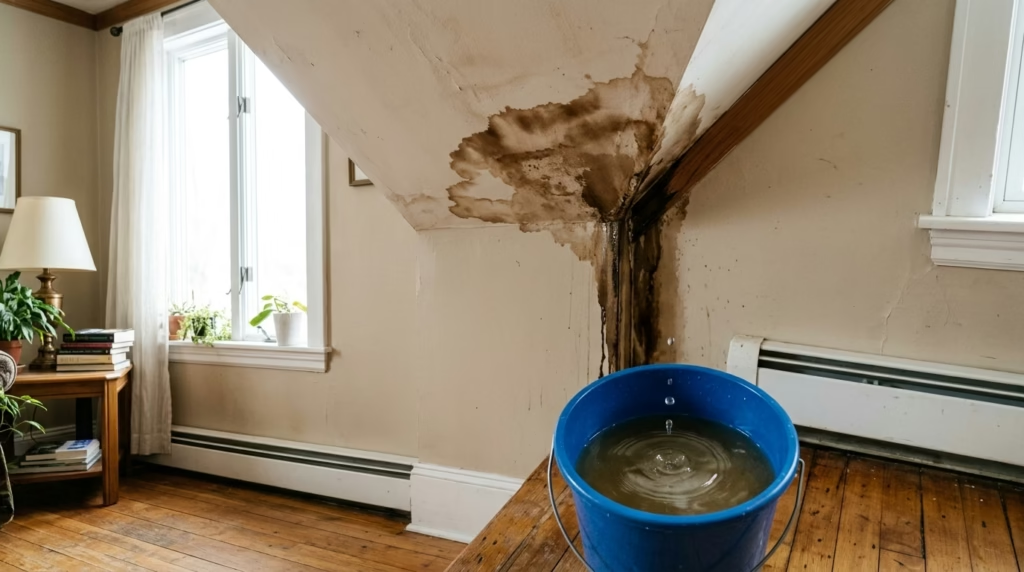
- Contain the water. Move furniture, electronics, and valuables. Put down buckets, towels, and plastic sheeting. If a ceiling is bulging with trapped water, puncture it with a screwdriver at the lowest point of the bulge and let it drain into a bucket — a controlled drain beats a ceiling collapse.
- Stop the source if you safely can. A tarp over the exterior leak area is the standard emergency move. If the roof is wet, steep, or it’s dark — don’t go up. Call for emergency tarping instead.
- Kill power to the affected area if water is near light fixtures, outlets, or the electrical panel. Water and wiring don’t mix; flip the breaker for that circuit.
- Document everything. Photos and video of the active leak, the stains, damaged belongings, and the exterior roof condition — timestamped. This is your insurance evidence. Don’t clean up before documenting.
- Call your insurance company to open a claim if the damage looks significant (more than a small stain). Ask about emergency mitigation coverage — most policies cover reasonable costs to prevent further damage, like emergency tarping and water extraction.
- Start drying within 24 hours. The mold clock starts ticking the moment materials get wet (see the timeline below). Fans, dehumidifiers, and removed wet insulation all help.
Save receipts for every emergency expense — tarps, fans, hotel if the home is uninhabitable. Insurers reimburse reasonable mitigation costs.
Documenting for Insurance: What Actually Matters
Insurance covers sudden and accidental water damage — a storm tears off shingles, a branch punctures the roof. It does not cover gradual damage from neglect, wear, or a leak you knew about for months. Your documentation should establish suddenness:
- Timestamped photos/video of the active leak and the damage it caused
- Weather records for the event (storm date, wind reports — easy to pull online)
- Maintenance history if you have it (gutter cleaning receipts, past inspection reports — these prove you weren’t negligent)
- A written timeline: when you noticed it, what you did, who you called
- Contractor assessments in writing, especially any statement about the cause (wind damage vs. wear)
Do not throw away damaged materials until the adjuster has seen them or given written permission. And get the roof repaired promptly — insurers can deny claims when homeowners let a known leak continue.
The Drying Process
Drying isn’t “it feels dry.” It’s getting moisture content in wood and drywall back to normal levels (typically under 16% for wood, under 1% above normal for drywall), verified with a moisture meter. Here’s the sequence professionals follow:
- Remove the water source — the roof repair comes first, always.
- Extract standing water — wet/dry vac, mops, towels.
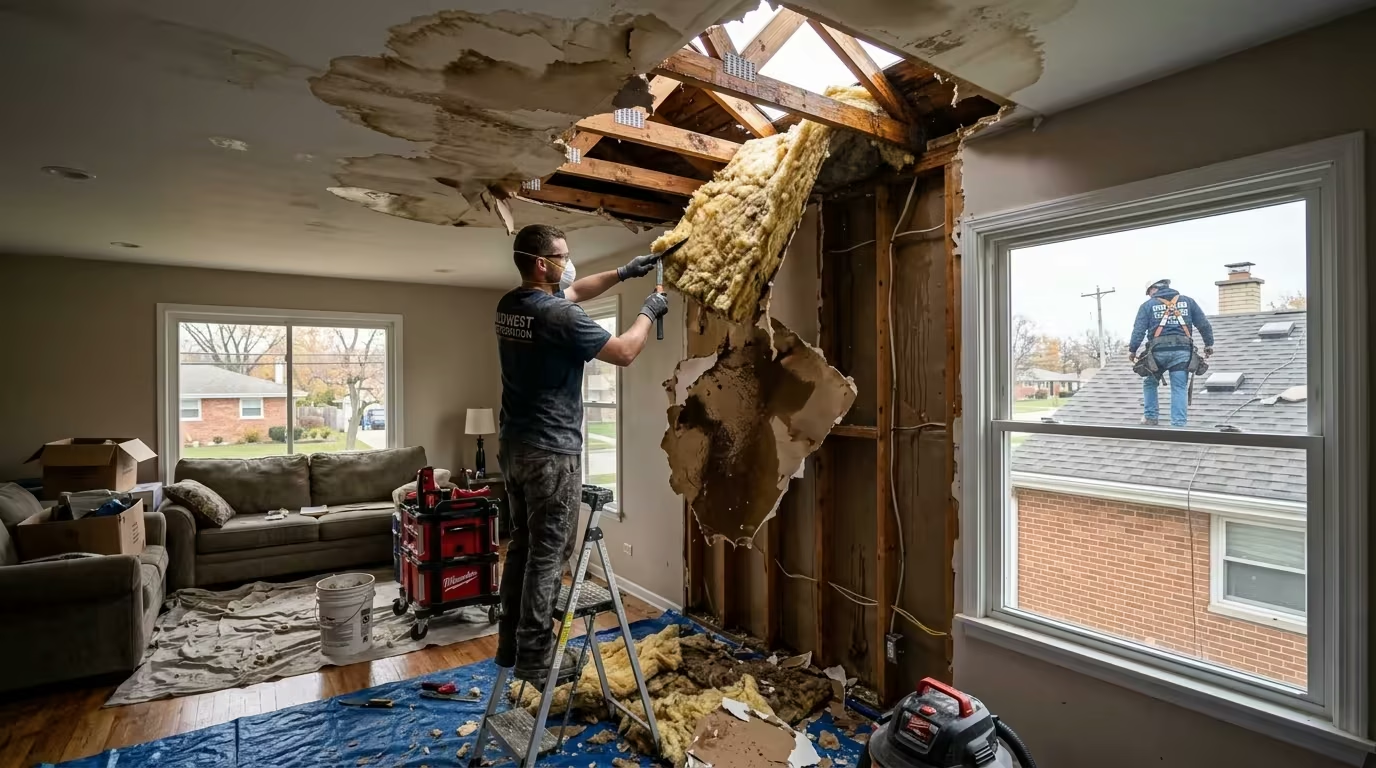
- Remove unsalvageable materials — soaked insulation (fiberglass batts lose their R-value when wet and rarely dry properly in place), sagging drywall, and any material that’s been wet over 48 hours in warm conditions.
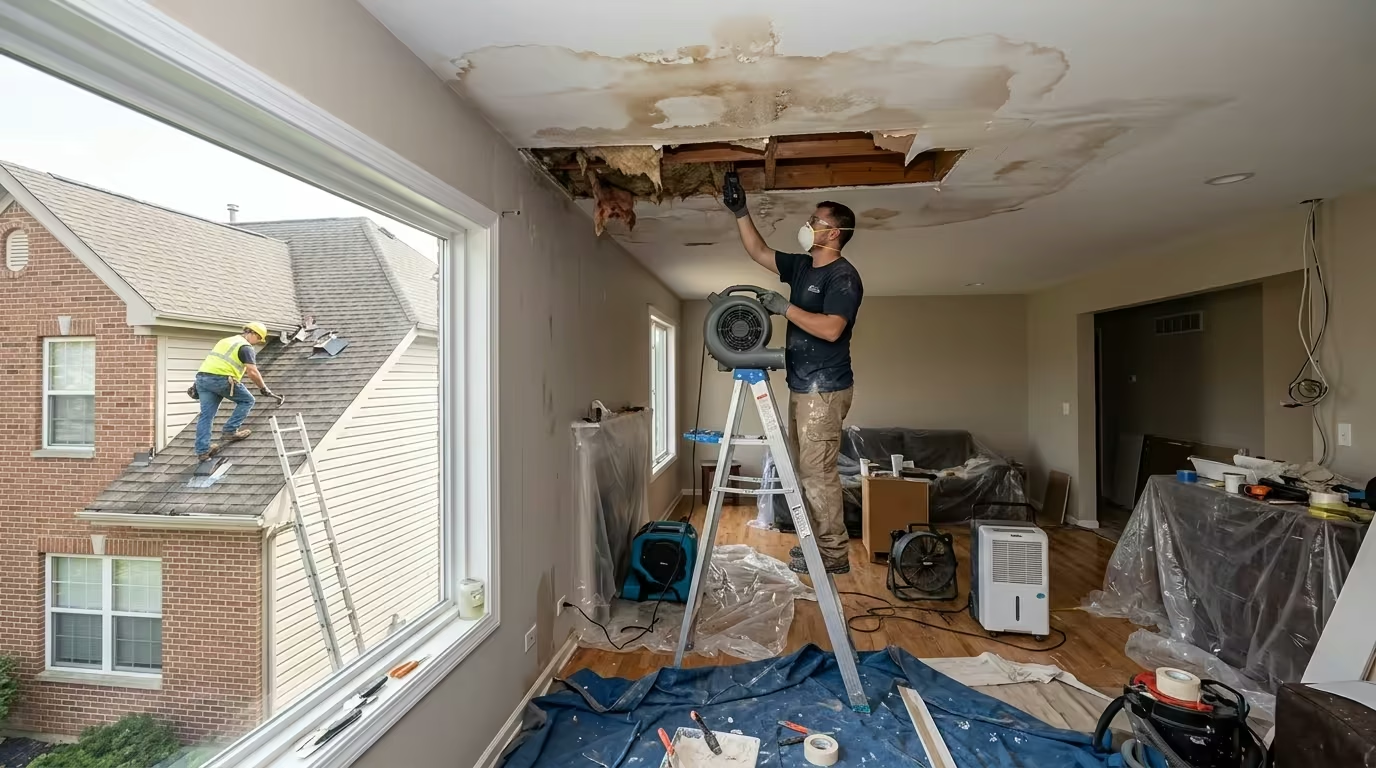
- Air movement + dehumidification — industrial fans and dehumidifiers running 24/7, typically 3–5 days for a contained leak. Open wall cavities dry faster than sealed ones.
- Verify with a moisture meter — surfaces can feel dry while the material behind them is still wet. Pros check, don’t guess.
- Treat for mold — antimicrobial treatment on affected framing before closing walls back up.
For a small, contained ceiling stain, steps 2–4 with a household dehumidifier and fan may suffice. For anything involving soaked insulation, multiple rooms, or standing water, professional water mitigation is worth it — and usually covered under the same claim as the roof repair.
The Mold Timeline: Why Speed Matters
This is the part most homeowners underestimate:
| Time wet | What’s happening |
|---|---|
| 0–24 hours | Materials are wet; mold spores present but not yet growing |
| 24–48 hours | Mold begins colonizing porous materials (drywall, insulation, wood) |
| 48–72 hours | Visible mold possible; musty odor develops |
| 1+ weeks | Established colonies; spores spreading through HVAC; health symptoms possible |
The rule: anything porous that’s been wet for more than 48 hours should be removed, not dried. Drywall, insulation, carpet padding, and ceiling tiles fall in this category. Wood framing can usually be dried and treated.
Health note: mold exposure aggravates allergies and asthma, and some people are highly sensitive. If anyone in the home has respiratory issues, treat mold remediation as urgent, not optional.
Water Damage Roof Repair Costs
Costs split into two buckets: the roof repair itself and the interior restoration.
Interior restoration costs:
| Repair | Typical cost range |
|---|---|
| Ceiling stain sealing + repaint (small area) | $200 – $500 |
| Drywall ceiling patch (per section) | $300 – $700 |
| Full ceiling drywall replacement (per room) | $800 – $2,000 |
| Insulation replacement (per area) | $300 – $800 |
| Mold remediation (contained area) | $500 – $2,000 |
| Mold remediation (extensive) | $2,000 – $6,000+ |
| Hardwood floor repair from water | $500 – $2,500 |
| Professional water mitigation (drying) | $1,000 – $3,000 |
Roof repair costs (the source fix) vary by cause — see our guides on asphalt shingle roof leak repair, metal roof leak repair, and roof vent leak repair for cause-specific ranges. Most single-leak roof repairs run $300–$800.
A typical “moderate” scenario — one leak, one stained ceiling, some wet insulation, caught within a few days — totals roughly $1,500–$4,000 all-in. A leak that ran unnoticed for weeks with mold involvement can easily reach $5,000–$10,000+.
When to Call a Professional (and Which One)
Different damage, different specialist:
- Active roof leak → roofing professional for diagnosis and repair, or emergency tarping service for after-hours.
- Standing water / soaked materials → water mitigation company (they extract, dry, and verify with meters). Many operate 24/7.
- Visible mold beyond a small patch (larger than ~10 sq ft) → mold remediation specialist. Small surface patches on hard surfaces can be DIY’d with proper protection; anything in drywall or HVAC needs a pro.
- Structural concerns (sagging ceiling, soft decking, rotted framing) → roofing contractor plus possibly a structural assessment.
- Insurance claim → your adjuster first, then your chosen contractors (you choose the contractor, not the insurance company).
One call can often start the chain: many roofing companies coordinate with mitigation partners, and vice versa. If you call us, we’ll connect you with the right local professionals for both the roof and the interior.
Preventing the Next One
Water damage is almost always a delayed leak — the roof failed weeks or months before anyone noticed. Prevention is detection:
- Check your attic twice a year (spring and fall). Look for stains on the underside of the deck, damp insulation, and daylight through gaps. Five minutes, twice a year, prevents most disaster scenarios.
- Know the 7 signs of a roof leak — small stains, peeling paint, musty smells. Catching it at the stain stage vs. the collapse stage is a 10x cost difference.
- Maintain the roof per our roof leak prevention checklist — gutters, flashing checks, post-storm inspections.
- In winter, watch for ice dam roof leaks — they’re the #1 cause of slow, hidden leaks in Illinois homes.
FAQ
How long does it take for a roof leak to cause mold?
Mold can begin growing on wet drywall and insulation within 24–48 hours. That’s why the drying response matters more than most people realize — a leak discovered Friday and left until Monday is already in the mold window.
Will my ceiling dry on its own after a roof leak?
The surface may look dry, but trapped moisture in insulation and behind drywall often isn’t. Without active drying (fans + dehumidifier) and verification with a moisture meter, you’re gambling on hidden mold. For anything beyond a tiny, quickly-caught stain, dry it actively.
Should I file an insurance claim for roof leak water damage?
If the damage is sudden (storm-related) and the repair cost clearly exceeds your deductible, yes. If it’s gradual wear or the cost is near your deductible, paying out of pocket avoids a claim on your record. When in doubt, document thoroughly and ask your agent — asking isn’t filing.
Can I stay in my home during water damage repair?
Usually yes, for contained repairs. Exceptions: active mold remediation (containment zones), no power to essential circuits, structural ceiling concerns, or extensive drying equipment making the space unlivable. Your contractor will tell you honestly — ask directly.
Who fixes the roof vs. the interior damage?
Typically two different trades: a roofing professional fixes the leak source, and a restoration/remodeling contractor handles drywall, paint, and finishes. Water mitigation companies bridge the gap (drying, mold treatment). Coordinate them in that order — there’s no point repairing a ceiling under an active leak.
How do I know if the leak caused structural damage?
Warning signs: sagging or soft spots in the ceiling, cracked drywall tape lines, a spongy feel to the roof deck from the attic, or visible rot on rafters/framing. If you see any of these, get a professional assessment before repairing cosmetically — paint over rot and you’re just hiding it.
Further Reading
- EPA: Mold Course — Chapter 2 — why mold grows after water damage and how to prevent it
- This Old House: How to Find and Fix a Roof Leak — step-by-step leak-finding and repair walkthrough from a trusted home-improvement source
External links open in a new tab and are provided for reference; we are not affiliated with these publishers.
Roof leaking in Carol Stream? Get help fast.
Call Carol Stream Leak & Restoration at (630) 866-1445 — we’ll connect you with a local repair professional serving Carol Stream, Bloomingdale, Glendale Heights, Wheaton, Hanover Park, Bartlett, and West Chicago. Related service: Ceiling Leak Repair in Carol Stream, IL.
Carol Stream Leak & Restoration is a local referral service that connects homeowners with independent local repair professionals; it is not a roofing contractor.